


 Twitter: filmimpressions
THE ONGOING MYSTERY OF THE ATTRACTION OF RAMESH SIPPY'S SHAKTI
The attraction of the movies is itself a bit of a mystery. Philosophy professor Colin McGinn explores the issue in his 2005 The Power of Movies: How Screen and Mind Interact. His focus is on the visual component of this audiovisual medium. He distinguishes between what we look at and what we look into: space, water, windows, flames, people's eyes, the flickering of light on a cinema screen. This last 'looking into' involves story and offers the possibility for utter absorption, the sort that our minds otherwise devote to our dreams.
But let's just suppose that one has seen a movie, perhaps many times, but one's ongoing connection with the film is not visual but auditory. Outside of a few exceptions, say, Lawrence of Arabia, my criteria for a good film is first and foremost a good soundtrack, and not primarily music and sound effects but rather the strength of the dialogue and the quality of the voices delivering them. I love color, and I love the power of the human face to convey fleeting or profound emotion. Yet in the end, for me, it is visuals which complement sound - our most primordial sense.
Given this basic penchant, what is it about Ramesh Sippy's 1982 Shakti, written by Salim-Javed, starring Amitabh Bachchan, Dilip Kumar, Smita Patil, Raakhee, Amrish Puri, and Kulbhushan Kharbanda, that makes me continue to listen (obsessively) to the film's dialogues for years on end?
Certainly, for me there's the language learning component. The choice of words and rhythm of the sentences is beautiful, excellent, then, for Hindi-Urdu study. But why this film? Why not one of the many others that I have also loved. Why not another Salim-Javed script - Sholay, Deewaar, or Trishul? Why not focus on some of Kader Khan's often playfully poetic dialogue from Manmohan Desai movies like Amar Akbar Anthony or Dharam Veer, which offer the bonus of the great vocal versatility that Manmohan Desai regularly got from his actors? The more recent Bunty aur Babli, written by Jaideep Sahni and directed by Shaad Ali, taps similar auditory nerves. Then again, why would I not choose to listen to a film that I can identify with, say, Aaja Nachle or Luck by Chance? I don't, after all, identify with the characters of Shakti. I don't understand them, not because they ring false, but simply because their reactions continue to mystify me. Their worlds are not mine, and yet the characters are written and brought to life by actors in such an intriguing way that I want to enter ever more deeply into the mental spaces they inhabit.
The mystery of the attraction is probably to be found in the mystery at the heart of the film, the mystery of the characters as they relate to each other, as they show themselves in changing lights, as their allegiances to each other change along with our allegiances to them. The story has become so personal that I find myself talking to the characters, sometimes hurting with them, sometimes taking them to task.
Vijay & Ashwini - Dialogue in Jail Cell
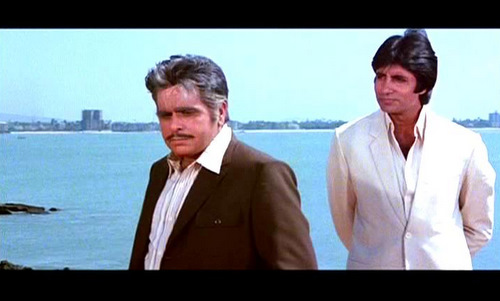
Ashwini Sahib (Dilip Kumar), how can you slap your wife (Raakhee) when, learning her 8-year old son Vijay has been kidnapped, she becomes hysterical and screams, 'agar Vijay ko kuchh ho gayaa to maiN apnii jaan de duuNgii' (If something happens to Vijay, I'll kill myself)? How can you then lovingly tell her, 'tum kyaa samajhtii ho, Vijay meraa beTaa nahiiN hai? mujhe uskii fikr nahiiN hai?' (What do you think, that Vijay isn't my son, that I don't care about him?) How can you minutes later seemingly forget your duties as a father and husband in favor of your image of yourself as a man in the service of the law? Sheetal looks on in pain and disbelief as you coldly tell the kidnapper over the phone, 'maiN jaantaa huuN ki mere beTe kii zindagii is vaqt tum logoN ke haath meN hai. kar do uskaa khuun. maar Daalo use, maar Daalo use, lekin maiN apnii farz se beiimaanii nahiiN karuungaa.' (I know that my son's life is at this moment in your hands. Kill him. Murder him. But I will not be unfaithful to my duty.) What is it like to live in a world where you treat almost everyone else as tum - including your family - while all others, except your boss, address you as aap, including your wife? Doesn't this skew your relationships from the very beginning, giving you a sense of power that you can easily abuse? In your way you care deeply for your son, and you are as hurt by Vijay as he is by you each time he misinterprets your intentions. In the powerful scene by the seaside Vijay lashes out defensively and you answer in sorrow and defeat, 'yeh bataane ke liye bulaayaa hai ki tumhaarii maaN bahut biimaar hai. voh mujhe kahtii nahiiN hai lekin maiN jaantaa huuN ki tumheN bahut yaad kartii hai. tumhaaraa aur meraa naataa to TuuT chukaa hai lekin agar maaN ke liye tumhaare dil meN koii jagah hai, to meraa mashviraa hai ki jaakar usse milaao. (I called you here to tell you that your mother is very ill. She doesn't say so, but I know she misses you. Our relationship, yours and mine, may be finished, but if you have any place in your heart for your mother, then I suggest you go see her.) In the end why must you on insist on being the person to bring your son to justice? You, no one else? Why the fatal bullet in the chest? Could you not have shot him in the leg to stop him running? And why must you wait until he is cradled in your arms, seconds from death, to have the conversation that could have spared you both years of pain and anger? Vijay: 'bahut koshish kii ki apne dil se mohabbat nikaal duuN, lekin maiN hameshaa aapse pyaar kartaa rahaa . . .(I tried hard to empty my heart of love, but I’ve always loved you.) Ashwini: maiN bhii tumse mohabbat kartaa huuN, beTe. (I love you too, son)
Sheetal (Raakhee), why threaten suicide when your son's life is in danger? At the same time, how is it that you can ever forgive your husband for going back on his word, for being ready to sacrifice Vijay? Do you realize that your son and your husband are in a tug of war over you? Shakti: female strength. You seem aware of your power over them but only fleetingly. Your answer to them both is eventually the powerless state of illness. Vijay visits your bedside and says, 'mujhse zyaadaa kisiko fikr hogii tumhaarii?' (Could anyone else care more about you than I do?) Your husband, too, shows a gentle, caring side when you are ill. And after you die, his cry, 'maiN tumhaare biinaa nahiiN rah saktaa, Sheetal' (I can't live without you) is heartfelt and moving. The man who has centered his life on preserving his iimaandaarii (uprightness, honesty) is utterly bereft. You provided him with an anchor that he always needed yet often ignored. In your wifely devotion - 'meraa ghar ek mandir kii tarah pavitr hai' (my house is as sacred as a temple) - you allow your husband to rule. Now concerning your son Vijay, why can you not accept that he would have any other woman in his life than you? Vijay is not, after all, sleeping around. He and Roma (Smita Patil) come together slowly and respectfully and wed when she becomes pregnant. Yet even when Roma dutifully pays a visit to her new parents-in-law, it is up to Ashwini to coax you into accepting her as your daughter-in-law. What would Freud say?
Vijay (Amitabh Bachchan), why are you so quick to rely on your fists? They give you only temporary victories. You brood and nurse your resentments, but just how sensitive are you, in fact, to your own motivations? You are following your father's example, you know? Your father obviously believes his own anger - which leads to police abuse - is righteous. Your violent reactions are born out of a similar need to right the wrongs of the world. I often ache with you, especially when you use the words of a dutiful son, say, asking politely to leave your father's presence - maiN jaa saktaa huuN? - only to be answered coldly - 'tum jaa sakte ho' (you may leave). It is a bit as though you had touched your father's feet and he had not pulled you up with the customary, warm 'jiite raho' (may you live long). At the same time, I want to scream at you: Can you not grow up and move on? Look at the many 'get over it already' messages from American cinema. In Postcards from the Edge (1990 - after your time, Vijay - dir. by Mike Nichols), Shirley MacLaine and Meryl Steep play a mother and daughter in conflict, mirroring the real-life struggles of the writer, actress Carrie Fischer, daughter of actress Debbie Reynolds. Having finally become drug-free, the Meryl Streep character is working with a fatherly director played by Gene Hackman. Streep: 'My mother, I know that she does all this stuff because she loves me, but I just can't believe it.' Hackman: 'I don't know what's happening with your mother. Maybe she'll stop mothering you when you grow up.' Vijay, your bearing constantly betrays a similar longing to be fathered. Yet when Narang Sahib (Kulbhushan Kharbanda) offers you fatherly love, you coldly rebuff him. Narang: agar meraa apnaa koii beTaa hotaa. . . (If I had a son of my own . . .) Vijay: zindagii meN jo kuchh bhii dekhaa hai, us ke baad yeh naam beTaa kisii gandii gaalii kii tarah lagtaa hai. (After what I've seen in life, 'son' is like a dirty word.) And are you any more sensitive to Roma than your father has been through much of his marriage to Sheetal? You have a tum-tum relationship with her. Yet she listens to you in a way that you never hear her. Even after you are married, she asks your permission to speak, 'Vijay, ek baat mere dil meN hai. kah duuN?' (I have something on my mind/in my heart. Shall I tell you?) Finally, you don't know it, but when you were a child, your mother threatened to kill herself if you died at the hand of the kidnappers. How is it that, visiting your gravely ill mother, you choose a similar wording, tum jaldii achchhii ho jaanaa, MaaN. Is liye ki agar tumheN kuchh ho gayaa, to maiN. . . (You get well fast, Ma. Because if something happened to you, then I . . .) Again, what bond is this between you and your mother?
Roma (Smita Patil), your diction and careful enunciation no doubt reveal much about you. Still, we want more of your back story, maybe your musical education, at least how you came to be orphaned. 'mere paas koii nahiiN hai' (I have no family), you tell Vijay's mother. You lead a life of great independence. 'gharvale hote to pareshaan hote. maiN akelii rahtii huuN' (if I had family, they would be worried; I live alone), you tell an amazed Vijay on your first meeting. Yet you seem willing to give up both your independence and your music and become a bahu (daughter-in-law), a status which, true, offers you protection from the vagaries of life and a sense of warmth and belonging, but which also supposes a life of service. You are quick to understand and slow to speak. 'kuchh baateN kahne kii nahiiN, sirf samjhne kii hotii haiN' (some things need not be said, only understood), you tell Vijay when he tries to express his feelings for you. Your spare use of words contrasts sharply with the depth of meaning you convey through your eyes. (And herein, granted, lies one of the limits of listening to this film.) Your father-in-law, who has announced that Vijay will be brought to justice alive or dead, 'hears' your eyes and answers, 'tumhaarii aankhoN se chhalki huii aansuueN mujhe aur kamzor kar deNgii.' (The tears flowing from your eyes will make me even weaker.) And yet it is you, the almost silent one, who will have the last word. Your son, Ashwini's grandson, has learned his family history, and announces that in spite of all its tragedy he will choose his upright grandfather's path. He too will become an upstanding police officer. 'pitaajii,' you say, 'ise aashirvaad diijie. jis shakti se zindagii ke har imtahaan se aap guzare haiN,vohii shakti se bhii mile.' (Father, give him your blessings that he may have the strength to face all of life's trials, just as you have done.) What strength is this if not yours?
K. D. Narang (Kulbushan Kharbanda), you have no children. You save young Vijay's life, letting him escape from his kidnappers. Have you never married? Are your feelings for Vijay only fatherly . . . ?
J. K. Verma (Amrish Puri), what does it feel like to be an exterior manifestation of the inner demons haunting a family? If you had a less powerful voice, would those demons be less menacing?
Beyond all these questions or mysteries, the dialogue of Shakti is particularly satisfying in other ways. There are brilliantly layered metaphors, as in the 'zahariilaa saNps' monlogue. Vijay has visited his bedridden mother. No matter how ill, she is firm: she will not accept his money for treatment. 'maiN abhii itnii kamzor nahiiN huuN, Vijay, ki maiN apne pati kii iimaandaari kaa bhoj na uThaa sakuuN.' (I am not so weak, Vijay, that I cannot bear the burden of my husband’s honesty.) 'beiimaanii kaa paisaa mere liye zahar hai, beTaa.' (Dishonest money is poison for me.) Vijay, in helpless despair, spends the night drinking. In slurred speech he explains to Roma the dysfunctional dynamics of his home. apnii maaN kaa beTaa main huuN aur merii sautelii maaN, yaanii, mere baap kii dusrii biivii kaa beTaa hai qaanuun, qaanuun. qaanuun meraa sautelaa bhai hai, sautelaa bhai. aur maiN to us ghar se bhaag gayaa huuN, lekin merii sautelii maaN aur mere sautele bhai ne merii maaN ko mere baap ke ghar ke andar qaid kar diyaa hai. (I am my mother’s son, and my stepmother’s son, that is, my father’s second wife’s son, is the law. The law. The law is my stepbrother, my stepbrother. I have fled from that house, but my stepmother and stepbrother have imprisoned my mother inside my father’s house.) He then compares himself to a poisonous snake, whom Roma should fear because he could strike her as well.
Satisfying too is the geometry created by the dialogue which has at its base the triangle. A series of interlocking triangular relationships are woven into individual scenes and from scene to scene. Whether three characters are present or two are present and a third is invoked, the pattern is too systematic not to be by design, be that at a conscious or a subconscious level. There is something about triangles. Buckminister Fuller, early-20th century visionary architect, scientist and mathematician, as a curious child, went from the assumption that the circle was at the heart of nature's geometry to the realization that it was the triangle. As an adult, he developed tensegrities* which have made possible the familiar geodesic dome as well as new ways of understanding both man-made and natural structures. Just maybe the strength that comes from marrying triangles into circles extends into the realm of story-telling. Just maybe we respond instinctively to triangles wherever we sense them. In art: take the fascinating movement our eyes make from person to person in Diego Velasquez's 1656 masterpiece painting Las Meninas (Maids of Honor). The circular nature of Shakti leaps out. At the beginning of the story, Ravi (Anil Kapoor) arrives by train, met by his grandfather. In the last, his grandfather sees him off at the same station, a young man now ready to make his way in the world, stronger for knowing hitherto tightly kept family secrets. What supports the entire circle, though, are triangles that form, collapse and then reconfigure. Three, three, three. Like poetic repetition, 'a basic unifying device in all poetry.'
'qaanuun, qaanuun. qaanuun meraa sautelaa bhai hai.' Repeated words, yes, but renewed with each shift in inflection of the actor’s voice.
So now, after all this delving, will I go on listening to the film, hearing the same lines repeated again and again? Probably so. And probably tomorrow the same lines will touch me in new and different ways.
*Tensegrity or tensional integrity is a property of structures with an integrity based on a balance between tension and compression components. (Wiki entry on Tensegrity)
The film Shakti can be watched on Youtube:

Comments