 ESSAY: Mary Kom, From Book To Screen
AND WHY THIS FILM MATTERS
There is a sense of enormous struggle and emotional charge to Mary Kom's life that Omung Kumar's 'sort of' biopic (it begins with a disclaimer that the film draws from incidents in the boxer's life, suggesting that they've been modified/fictionalised) doesn't bear out. A reading of her autobiography, Unbreakable, confirms this suspicion and yet miraculously, the film still offers us glimpses into her remarkable journey. The signs are there, if only as markers.
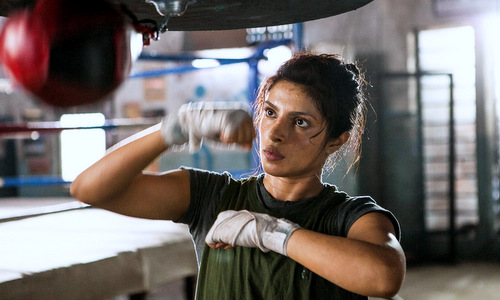
Take for instance the tense political climate in Manipur. The screenplay employs a curfew as setting for the opening sequence when Mary (Priyanka Chopra) and her husband Onler (Darshan Kumaar) are trying to get to the hospital as she’s in labour. The cops first pick Onler up on suspicion of being an insurgent, then give them a ride in their jeep. This is pure fiction. Later, after the birth of their twins, a friend jokingly asks her to make sure that the next time around she picks a better time. Which, while being just a flippant comment, is suggestive of the real stresses of living in a strife-torn region.
On way to the hospital a group of gun-totting rebels stop the jeep and the only reason they are spared is because their leader recalls how Mary once bravely took him on in an amateur-fighting match. The same man is later seen listening to the radio commentary of one of her famous wins. This too appears to be largely untrue. Yes, Mary’s family had no money to fund her passion for boxing, but that didn’t require her to get into a staged hand fight with a beefy man while the crowds jeered and cheered. That’s the Hollywood touch. Like the initial tension between her and her coach (Sunil Thapa) is drawn straight from Clint Eastwood’s Million Dollar Baby where the actor-director plays a boxing coach who refuses to take on the protagonist (Hillary Swank) till she proves her commitment just by showing up at his gymnasium every single day.
And so it goes on. Kumar has taken the bare bones of Mary’s life and structured a predictable underdog story—of one woman who fights not just poverty and family resistance but also the favouritism and dirty politics of the Indian Boxing Federation to become a national hero. True, Mary Kom deserved a better film, which wasn’t one-dimensional and almost dull; so much so, the filmmaker has to literally exhort the audience to take patriotic pride in her sporting achievements by playing the national anthem in-film and asking us to stand up in deference.
I’d have also preferred the narrative to focus on her individual struggle and particularly the hardships her parents and siblings put themselves through for her sake. That’s the most affecting part of her autobiography. No, she didn’t discover a boxing glove in the wreckage of a plane crash as a little girl and take instantly to it. She was interested in sports as a schoolgirl and was first training to be an athlete. Boxing happened only later in her teens when she was found to have a natural talent for the sport and started living in Imphal to train.
There are innumerable people from her family and community who’ve supported her through her journey from a small village in a distant state to becoming an Olympic medal winner and five-time World Amateur Boxing Champion. These people are left out of the narrative and that’s ok. But her parents who literally worked their backs off for the sake of their oldest and often at the cost of her siblings didn’t deserve to be short-changed—particularly the father who’s painted as a dominating patriarch, always critical and discouraging.
Again the glimpses we get of the family’s circumstances and the difficulties they must have faced is to be gleaned from the state of their home, their clothes, the rugged faces of the actors (except Chopra who never fits into the milieu). The remoteness of this region, of its being far removed from the mainstream is to be inferred from references to the step-daughterly treatment meted out to the Manipuri boxers by officials like Mr Sharma (a caricature even if such people exist all around us). And from the fact that she was forced to take on the name Mary Kom (Kom being the name of the tribe she belongs to) because her real name, Mangte Chungneijang, was difficult to pronounce for people from the mainland.

We never get to see Manipur because the film wasn’t shot there. (It also isn't getting released there because the insurgent groups have banned Hindi films in the state). But we now know that a diminutive woman finally put it on the national map. I’d have liked this woman to be played by someone who looked like her, who could articulate her struggle with authenticity. I don’t think Chopra is that woman, even granting that the screenplay doesn’t give her much room to manoeuvre. The typically reductive analysis of her personality is that she’s a tomboyish girl who likes to get into fights all the time, has a temper problem and finds succour in boxing. Yes, later we also learn that she likes to cook and wear nail polish like any other regular girl.
But when does Mary come alive in the narrative? Ironically, it isn’t in the boxing ring—even for someone who has no interest in or understanding of the sport one gets the feeling that the matches are tepidly filmed—but at home with her twin sons trying to juggle her life as a mother while easing back into training.
Which brings us to the film’s most interesting character, Onler, who, as the true story goes, met her in Delhi and was her friend for a long time before he proposed marriage knowing that any other man she married was unlikely to support her career. Incredibly, not only did he promise to do so, he actually did it, putting his own ambitions away and taking charge of the house and their twins. Which is remarkable, given that the romantic idealism of most men doesn’t survive beyond the altar and certainly not after the birth of children.
Yet Mary’s own words bear out the role-reversal in their relationship, Onler’s readiness to not just play homemaker but also bear the agony of long periods of separation from his wife who needs to travel extensively for training, tournaments and now also for public engagements. This character is exceptional, particularly in the realm of Hindi cinema where men don’t have the option of playing second fiddle.
It is for the same reason—the myopic, misogynistic world-view of our cinema (as indeed our society)—that Mary Kom is an important film. For putting a woman at the centre of the story and never taking the focus away from her, for celebrating her struggle and her achievements and for suggesting that it is possible to challenge the status-quo on gender roles, career choices and our ideas of heroism.

Comments