


 ESSAY: Bombay Talkies
CINEMA OF DELUSION
Warning: SPOILERS AHEAD
Towards the middle of Bombay Talkies, in Dibakar Banerjee’s short film, Star, actor-in-exile Sadashiv Amrapurkar emerges Yoda-like from a dumpster, every dint a doyen of Marathi theatre, unusual abode notwithstanding. Nawazuddin Siddiqui plays Purandar, his son or protégé (as seen in Banerjee’s Oye Lucky Lucky Oye with Paresh Rawal’s character, Amrapurkar is presented as an amalgam of a man’s father figures). Purandar has chanced upon a part in a big film, with just an exclamation by way of dialogue. Still he submits himself to a semblance of rehearsal, mostly by mouthing the filmi lines that are a part of every bit actor’s repertoire. The ‘father’ emerges as a taunting hallucination, and Amrapurkar, tantalisingly in his element, draws nuance from bombast, and breaks down the tenets of raw performance that may well be beyond Purandar’s reach. Purandar is a never-has-been, an eternal ham whose funny faces and odd tales even his daughter doesn’t find funny anymore, although he has tasted blood on stage in the distant past. He lives dissolutely in a chawl, and is an object of much amusement amongst its residents, not least because he keeps an emu as a pet, and the daily barbs add to the din of ridicule that seems to inform his life.
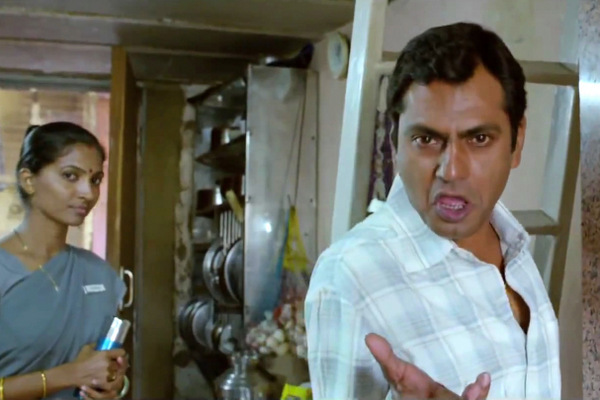
The segment is based on Satyajit Ray’s story, Patol Babu, Film Star, in which a 52-year-old one-time actor is taken up for a walk-on part in a film, and those few moments in the arclights prove to be a cathartic experience for an actor shorn of opportunity. Banerjee takes that fable-like element, but masterfully creates a story that doesn’t diminish its protagonist, or leave him in awe of an incidental moment. After the shot is canned, Purandar rushes home, with scarcely a thought for his fee, because he finally has a brand-new story to tell his daughter. We watch him animating the day’s occurences, converting small change into the goodies of the world. It is gallant shadow-boxing made beautifully resonant by the stature Siddiqui lends Purandar, something that grounds him as much as it lifts him. Banerjee feeds his delusion but also allows him an escape route through a layered and well realised characterisation, because he seems to have given Purandar the agency to see his life for what it is. We end up leaving the man, not pitying him, but with a begrudging respect for that elusive star-quality within, that Banerjee so effectively taps into.
Unfortunately, Anurag Kashyap’s Murabba, treading the same turf, has quite the opposite effect. Kashyap takes out the superstar and places him, in the real-life person of Amitabh Bachchan, within a wood-panelled fortress, outside which a mêlée of devoted fans gathers every day, the markers of mass hysteria very much in evidence. Around this lurch opportunists and flunkeys, including a Bachchan lookalike (played with wry irony by Virendra Giri) who has created a sideline from this common adulation. To this mileu, arrives the strapping Vijay (Vineet Kumar Singh) from Bachchan’s hometown whose mission is to get Bachchan to eat one half of a pickled gooseberry. The other half, administered to his father, would cure him of his indisposition—a nod to Bachchan’s pre-eminence that makes a miracle-worker out of an actor.
However, Kashyap’s storytelling leaves much to be desired. Vijay, the self-avowed minion is virtually battered and trampled underfoot, and reduced to a blethering mess. If there was some character to his man, Kashyap leaves no semblance of it, stripping him of his humanity. There is also an absence of cinematic sensibility that renders Murabba an inert and pointless excursion into the kind of navel-gazing that the film industry often indulges in, creating myths from its own tropes, stemming from a mistaken belief that cinema engulfs the unmoored lives of the common sort. At the very end of the piece, Vijay seems to have arrived at some self-awareness, but by then the damage has been done.
Zoya Akhtar’s short, Sheila Ki Jawani, opens with wide-eyed children in well-appointed, almost manicured, households, attesting to their life’s ambitions—the old tinker, soldier, sailor, spy spiel. It’s a strangely cloying opening to what could have been a charming little fable of a little boy, Vicky (Naman Jain), who wants to grow up and become Katrina Kaif (appearing as herself), hence the film’s title from her popular ‘item’. Akhtar appears to champion an effulgent kind of personal expression—Vicky applies make-up and stomps about in high heels—unencumbered by stereotypical notions of gender (for example, the roughshod masculinity of the football field where his father would rather he shone) that sometimes tie down children, whose innate persuasions may not fit the formula. It isn’t clear in which direction destiny may lead Vicky (he’s only eight), whether in terms of gender identity or sexuality—implications Akhtar chooses to ignore—but a strong comment is made on the nurturing (or the lack of it) that only parents can provide to such a ‘different’ child at this impressionable age, with Swati Das and Ranvir Shorey pulling off the blinkered parents realistically.
What mars this narrative is that Akhtar seems to have woven in riffs from the French-Belgian film Ma Vie En Rose (1997), also dealing with a young gender dysphoric child. Key moments seem to have been clumsily borrowed, too selfsame to be mere coincidences, but the considerable emotional power of the original is still laid to waste. Because Bombay Talkies has been proclaimed as a centenary film, which will also play in the Cannes next week, this is rather perturbing, much in the way last year’s Barfi was not just a self-declared tribute to a hundred (or more) years of Hollywood, but also to, ironically, as many years of borrowing by our cinema.
That be as it may, Akhtar heads on to a denouement which is entirely her own. Vicky and his sister, improbably put together a lavishly mounted fund-raiser to collect a measly two hundred and fifty rupees, where he can finally dance to Sheila ki jawaani with gay abandon, with women and children from the housing society in full attendance, taken aback by his reckless audacity, and mesmerized by his dhinchak moves. Vicky is giving voice to his precious dream—to be Katrina in a rustle of sequins and feathers—consequences be damned. However, it is still a convenient wish-fulfillment scenario that seems to over-simplify the real-life anguish, frustrations and insecurities of children who march to the beat of a different drummer.
Also treading queer territory, Karan Johar’s Ajeeb Dastan Hai Yeh strings together a series of popcorn moments to pull off an unsettling contemporary story involving Gayatri (Rani Mukerji), who is in many ways a woman of the world with her matter-of-fact poise and disarming sexual allure, but still disfigured by a marriage that hasn’t exactly been sexually fulfilling. Her husband (Randeep Hooda) is a closeted homosexual, and it takes an intervention by a young gay copy-writer (Saqib Saleem, acquitting himself well) at Gayatri’s office, to expose the hypocrisy that is stifling both lives. Mukerji is devastating in a scene where Hooda attempts to make love to her, and for the first time, she realizes (or acknowledges) that she has been a guinea pig to the attempts by this man (suddenly a stranger) to reaffirm his tenuous hold on those notions of straight masculinity that pushes every other kind of orientation underground. It is a revelatory moment that a smoldering Mukerji nails perfectly with just her expressions (although Johar gives her lines later by way of exposition) even as she removes the incriminating pancake from her face, chastened by the truth.
A morose Hooda suffers from a lack of characterization, and is given a room full of Bollywood LPs (a nod to the film’s central conceit) to drown his sorrows in, and the most obvious Lata melodies (like Lag ja gale and Ajeeb dastaan hai yeh) can be employed to strike a chord with his embittered self. Perched at the other extreme, is Saleem’s character, who seems to have embraced his sexuality, but with a kind of internalized heart-ache that makes him a perennial victim. He recognizes no boundaries in his personal dealings, as seen in the sex talk that marks his egregious (but hilarious) first exchange with Gayatri, or in his relentless (but wholly inappropriate) pursuing of her husband. These two characters, both damaged goods, can hardly be described as affirming portrayals of contemporary gay men, which is uncannily tied in with Johar’s own limited world-view of alternative sexuality, as evinced by the litany of doomed homosexuals who frequently crop up in his films. However, Mukerji’s and Saleem’s crackling chemistry in their sequences together injects warmth and mirth to the sometimes trite lines, making this an entertaining piece that demonstrates Johar’s ability to deftly handle themes not typically associated with his cinema, even if his politics remain misplaced.
With its four tales, Bombay Talkies draws us into the world of make-believe and illusion, where delusions rule supreme, much like the film industry and the satellite cultures it spawns. Sometimes a delusion that stares itself at your face must be finally discarded, as in the case of Mukerji’s character. Sometimes it must be milked for a moment of rare succour, as Banerjee does for the hapless Purandar in the best piece in this assemblage. Sometimes, it isn’t a delusion after all, as the young boy demonstrates in Akhtar’s story. Or, as in Kashyap’s misfire, a man’s character is reduced tenfold by a delusion seemingly shared by millions. Then there is the monumental delusion of grandeur that the film industry itself partakes in readily, very much in evidence in the gaudy star-heavy closing number that seems not so much a celebration of a film culture’s passions and vision, as much as of its mendacity.✑


I liked Bombay Talkies. For the fact that there was no moral, no 'end' to any story. Just experiences of seemingly real characters, tied in some way to the film industry.
The end sequence was awe-inspiring in some ways and incomplete in most. There was no celebration of its history, its failures, its phoenix rises, its beginning. The end sequence was more of an item song with attractive mainstream faces, than anything else. Where were the Vinay Pathaks, Konkona Sens, Nana Patekars,Boman Iranis of the industry?
Karan Johar's direction was the finest amongst the 4 - lucid, elaborate, seamless. The story was predictable. The industry tie-in was incidental.
Dibakar Banerjee's was definitely the best story and the one that I felt most deserved an end a little less vague in a popular way.
Zoya Akhtar's was an endearing tale that was left with too much suspension of disbelief. From Katrina Kaif literally teaching a kid to lie to the final dance scene in an improbable for children to create setting. It started out great, took too much time to come to the point and then fizzled out in an abrupt end.
Anurag Kashyap's short was loopholeless, like most of his works. But, it failed to make an impact. But it definitely was a needed piece to finish off a centenary celebration of Indian cinema.
Sadly, Bombay Talkies itself, was a celebration of not more than 50 years of specifically Hindi cinema and a sad excuse for a centenary celebration film.
Posted by: Anish Vyavahare | May 07, 2013 at 13:50