


 REVIEW: Memories In March
LIVING IN THE SHADOW OF A DEATH
Grief unfolds at a pace and manner of its own choosing. It's expression is unique to each individual and often, defies generalised perceptions. In Sanjoy Nag's trilingual film Memories in March, grief is the defining feature of Deepti Naval's face -- even when it looks outwardly composed, when it smiles, when it undertakes a mundane conversation with the building chowkidar. Or when it lashes out in rage against a shocking discovery -- even more shattering perhaps (at least momentarily so), than the news of her son Siddharth's death.
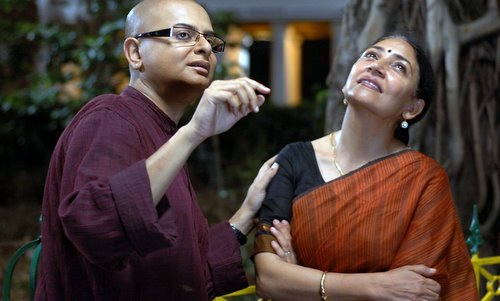
Unfortunately, Ms Naval's seasoned, calibrated performance is off-set by an equally stilted and stultifying act by acclaimed Bengali filmmaker Rituparno Ghosh, who plays Siddharth's mentor and lover, Ornob. Not only does his overbearing rendition of Ornob mar the film, it destroys a beautiful, sensitive character, a rare humane portrayal of a homosexual in Indian cinema. Mr. Ghosh isn't comfortable before the camera; his mannerisms turn out more theatrical than necessary and when confronted with an actor of Ms. Naval's class, he falls even flatter than he may otherwise have.
This is a crucial impediment to the enjoyment of a poignant film that unfolds as painfully slowly as time would appear to pass for a person who has just unexpectedly lost the person she loves the most. Siddharth's voice and his presence haunts the entire narrative, even though we never get to see him. It's a wonderful touch, because recreating him in flashback would have reduced the intensity of Aarti's and Ornob's anguish. And yet we're taken back more than once to the night of his fatal accident, to a car turned turtle, a grievously injured body being removed into an ambulance and later, a mother and a boyfriend who keep revisiting the site to make sense of the tragedy.
The third important player in this drama is the ever-dependable Raima Sen as Siddharth's colleague Shahana, whose own feelings for Aarti's son are almost as intense as the other two, but she's practical, sensible and far less caught up with emotion. Even when she tells Aarti about her long-standing crush on Siddharth, she's matter-of-fact about being rejected.
Aarti describes herself as a conservative woman. She can scarcely begin to accept her son's sexual orientation and echoes the common belief (is it still just as rampant?) that homosexuality is a psychological disorder that can be cured with counselling and medication. But while her moral values may be traditional, her personality is decidedly modern and in many ways, more liberated than most women.
Throughout the film, we witness her innate dignity. When Shahana asks her if she'd like her to stay over, Aarti firmly refuses and spends the night alone in her dead son's apartment. She does the same when the office offers to pick up the tab for her air ticket. She matter-of-factly calls up her ex-husband in the US more than once, and leaves messages on his answering machine. But when Ornob hesitates to part with sketches and photographs pinned on Siddharth's office tagboard, she loses her cool and vents her fury on him, leading him to describe her outburst as 'melodramatic'.
Ornob is a very opinionated man. I liked that immensely about him. He's probably so in the face of being judged and labelled by society at large. At one point he asks Aarti, "Which of the two is more unacceptable to you -- that Siddharth is dead, or that he was gay?" Or then, is it the fact that he never trusted his mother enough to confide in her about his relationship and that she had to finally get the details from an unsent mail drafted on his mobile phone?
Ornob's one breakdown scene is brilliantly written. He visits Aarti at the apartment to give her the things she wanted from Sid's office desk. Aarti, who's also calmer after spending a night mulling over the dreadful (for her) revelation, asks him to keep everything except a photograph of her from her younger days. Ornob refuses to part with it saying it defines Sid's mother to him -- the woman Sid loved so dearly and described so fondly and in such detail; and who, he says, may look like the woman sitting before him, but is nothing like her at all!
Nag handles the delicate and awkward relationship between Aarti and Ornob with great restrain. And while Mr. Ghosh may not be a natural born actor, trust him to come up with the most poetic and befitting lines (he has written the film's dialogue and lyrics). When Aarti and Ornob are trying compose a message to put on Sid's Facebook account, he comes up with this gem -- "If I have to go away, can I leave a bit of me with you?"
Memories In March is all about the things people leave behind and the way in which their loved ones try to recompose them in their hearts. And you're more than willing to forgive the forced arty elements like Ornob's rant about 'putting things in boxes' or of the railing that Sid's car rammed into getting fixed towards the end -- to signify the mending of broken hearts.
And oh please, somebody write roles for Deepti Naval. If an actor of her talent gets such sporadic work, it's a monumental loss for Indian cinema.


Comments