


 ESSAY: The Marathi Renaissance
THE SONG OF REVIVAL
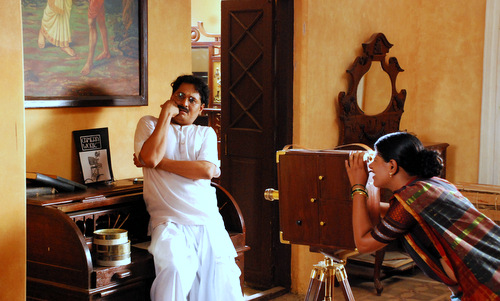
Till Paresh Mokashi made Harishchandrachi Factory (2009), all we knew about Dadasaheb Phalke was that he directed India’s first fiction film Raja Harishchandra (1913) and there’s an award named after him. Mokashi’s vision transformed this pioneering effort into the adventures of a Chaplinesque hero obsessed with moving pictures and prepared to stake everything to fulfill his impossible dream. Interestingly, Harishchandrachi Factory was bankrolled by none other than UTV, a sure sign of the dramatic turnaround in Marathi cinema after the remarkable success of a small (and not necessarily classic) film called Shwaas (2004), which won the National Award for Best Feature Film and literally breathed new life into a floundering industry.
The two decades before Sandeep Sawant’s Shwaas were unarguably the darkest period in Marathi film history––living in the shadow of glamorous big brother Hindi cinema was proving calamitous despite state subsidies and the general mood of despondency reflected on the abysmal quality of the output which had, at one point, trickled down to less than a dozen films a year. It is to the credit of filmmakers like Amol Palekar, Sumitra Bhave-Sunil Sukhtankar, Sachin Pilgaonkar and Smita Talwalkar that they tried to keep the boat afloat with their progressive socials, gentle comedies and middle-class dramas based in Mumbai and Pune.
Coupled with the success of Shwaas were the twin coincidences of the multiplex revolution and upsurge of Marathi movie channels which required round-the-clock content. It wasn’t long before television houses and Hindi producers started financing small-budget low-risk Marathi films. With the money came the talent that had thus far failed to find a viable outlet. Young directors like Nishikant Kamat, Umesh Kulkarni, Ravi Jadhav, Satish Manwar, Satish Rajwade, Kiran Yadnopavit and Sujay Dahake have spearheaded this renaissance with themes ranging from social satire, rural exploitation, urban angst and gender bias, to musicals, coming-of-age stories and old-fashioned romances. They also infused the cinema with sophistication, the most notable example being Dahake’s Shaala, a simple enough story about the pangs of growing up (adapted from literature, another important revival), but employing layered screenplay and precise visual design to heighten the pleasure.
Atul Kulkarni brought his Hindi experience to Natarang (2010), a film about a strapping body-builder who transforms into a cross-dressing ‘naachya’ for his love of the folk art of Tamasha and the upheavals it causes in his life. Kulkarni dramatically lost and put on weight for the two halves of the film, but more crucial was his body language and the understanding with which he externalised his character’s divided self. Natarang also revived the great musical tradition of the Marathi screen in the form of talented duo Ajay-Atul, brothers who have subsequently made forays into Hindi, but retained the flavour of the Marathi soil.
V. Shantaram, among the greatest innovators of Indian cinema, would have been proud of a film like Natarang. His early work for Prabhat Studios, which he formed with three other partners in 1929 first in Kolhapur and then moved to Pune where the FTII now stands, reflected a freshness of ideas and experimentation with film form and technique rarely seen thereafter. In keeping with the ethos of the times Prabhat first produced historicals and mythologicals––early Marathi cinema drew heavily from the sangeet natak and although they sometimes tackled social themes, there was a pre-eminence of costume dramas. Shantaram made the first Marathi talkie Ayodhyecha Raja (1932) while Sant Tukaram, based on the life of the great 17th century poet-saint and directed by his partners Damle and Fatelal, travelled to the Venice Film Festival in 1937 and was ranked amongst the three best films of the year at the prestigious event.
But with Kunku ((1937), also produced as Duniya Na Mane in Hindi (studios like Prabhat had the foresight and the funds to make bilinguals), they paved the way for socially relevant cinema that would prove to be the bulwark of the Marathi industry.Kunku’s fiery heroine is amongst the few genuine feminists of the Indian screen and its continued relevance is testimony to Shantaram’s and actress Shanta Apte’s modernity.
Apte, along with Kamlabai Gokhale, Durga Khote and Shobhana Samarth were among the first women from respectable families to make acting in films acceptable--Harishchandrachi Factory records how hard it was for Phalke to find his Taramati (even professional sex workers shunned the new medium) and eventually he settled for a male actor in keeping with theatrical tradition where stars like Bal Gandharva (the subject of a well-produced biopic a couple of years ago) regularly played female parts. By 1938, things had changed enough for Meenakshi to get into a swimsuit and woo the shy hero with a mischievous song in Master Vinayak’s Brahmachari.
Following the decline of Prabhat, directors like Bhalji Pendharkar (known for his historicals and rural socials) and the urbane Raja Paranjape (Marathi equivalent of Bimal Roy and Hrishikesh Mukherjee’s humanism) ushered an era of thematic and musical distinction. The latter joined forces with the fine lyricist-composer duo, G.D. Madgulkar and Sudhir Phadke, to create timeless melodies that resonate through the Marathi speaking world to this day. P.K. Atre a noted satirist and journalist directed Shyamchi Aai (1953) the only Marathi film before Shwaas to win the Golden Lotus Award––Umesh Kulkarni’s Deool joined the list last year.
And then there was Dada Kondke, the son of a mill worker who produced, directed and acted in some of the biggest hits of the ‘70s relying on bawdry humour and folksy music to regale the frontbenchers. Simultaneously, a young paediatrician with a theatre background, Jabbar Patel, was treading the off-beat path with his scathing political critiques (Saamna, 1975), Sinhasan (1979), both scripted by playwright Vijay Tendulkar). Patel also directed Smita Patil in Umbartha (1982), produced as a bilingual, and Jait Re Jait (1977) a terrific musical set in a small adivasi community embellished with Hridaynath Mangeshkar’s earthy compositions.
The current New Wave of Marathi has originated in the land of Prabhat, and borrows from Iran’s cinema of resistance, in that, it often uses children’s stories to make dark, reflective social comment palatable for audiences. Alongside cheap imitations of Hindi cinema which still form a bulk of the annual output, there now exists a distinctive space for alternate voices who are singing the song of revival in unison.
(This article first appeared in Outlook magazine as Amchi Pichchur)


Comments