


 ESSAY: Salaam Bombay - 25 Years And Counting
THE OTHER SIDE OF THE TRACKS
Mira Nair’s debut feature film Salaam Bombay which is celebrating its 25th anniversary this year and had a limited re-release last week, begins like any other conventional film with an underdog hero. Young Krishna (Shafiq Syed with a brilliant screen presence), barely 12 years old, is abandoned by his boss, the manager of a circus, and left to fend for himself with hardly any money in his tattered pockets. He walks up to the nearest railway station, asks for a “bade sheher ka ticket” and arrives in Bombay. In popular cinema he’d have encountered kindly folk all around or stoked his angst to grow up as a messiah for other lost souls like himself, either becoming a smuggler/pickpocket or then, somehow managed to put together the 500 rupees he needs to take back to his village in Karnataka before his mother will accept him back (he ruined someone’s bicycle and has been sent off to make good the loss), his makeshift family bidding him a teary farewell.
But this is not a conventional film, hence Chaipau, as he is immediately rechristened (because he works at a tea stall), is thrown into the thick of action minutes after arriving at Grant Road—the film doesn’t explain how he gets there from the train terminus. For those who aren’t familiar with Bombay, Grant Road is the ideal location to explore the city’s schizophrenic persona. Get off on the East and the infamous red-light district of Kamathipura is barely a kilometre away. On the West, at exactly the same distance lie the city’s poshest neighbourhoods of Malabar Hill and Breach Candy. Somewhere in between are middle class housing colonies and old Parsi buildings all jostling for the limited space the island city has to offer.
Nair’s decision to locate the narrative in Foras Road rather than elsewhere in Bombay seems a deliberate ploy to highlight the distance between these disparate worlds on either side of the railway tracks that are bound to rub and clash sooner than anyone is prepared to accept. In the narrative of ‘the outsider gazing voyeuristically into this netherworld from a safe distance as a stepping stone to international stardom’ (with foreign funds curiously mixed with local government sponsorship) is lost the fact that any filmmaker’s take on such a life as she doesn’t dwell in is likely to be romantic/idealistic and governed by her own privileged sensibility. But equally true is the fact that nobody in mainstream cinema wants to cast an eye on this garbage heap of Indian cities and any attempt to do so is quickly dismissed as poverty porn, and just as readily lauded in the First World, the inexplicable success of Slumdog Millionaire being a classic case in point.
Chaipau’s temporary ‘home’ is a grim neighbourhood––filthy, cramped, and ruthless––but human resilience is greater than the most abject circumstances. There exists the possibility of hope and cheer even in the midst of squalour; in garishly painted brothel rooms, grubby footpaths, desolate station yards and overcrowded streets. Chaipau makes a few friends (again we don’t know how) and although their circumstances are as hopeless, they manage to laugh sometimes and are given to all the same emotions––love, despair, jealousy and loyalty––as the rest of us. But first they must survive, and that’s a daily struggle.
Nair and co-writer Sooni Taraporewala cast a keen, compassionate eye on this miserable world inhabited by obdurate brothel madams (Shaukat Azmi), forlorn prostitutes (Anita Kanwar), brutal pimps (Nana Patekar) and drug-addled handymen (Raghubir Yadav, the effortless show-stealer). In the midst of these desperate adults live a bunch of feisty kids invested with enough blood so that we experience a physical ache at the sheer unfairness of their lives.
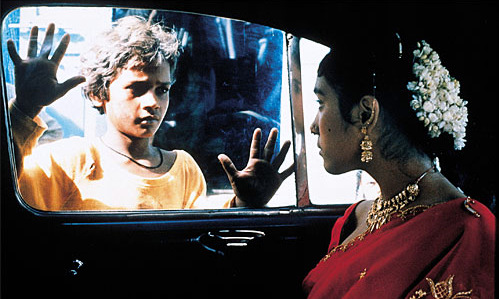
Take Manju (Hansa Vithal), for instance. Slightly younger than Chaipau (and looking still younger), she’s the daughter of Rekha and Baba (Kanwar and Patekar) growing up in a seedy, uncaring world where she is separated from mother and her clients by a mere glass door. Rekha wants to protect her from this environment and from Baba’s ire, yet knows it’s a lost battle on both counts––the scene where Baba punishes Manju in a moment of rage is terrifying. The little girl is fond of Chaipau and resentful about his affection for a young mute entrant to the brothel whom he addresses as Sola Saal (Chanda Sharma). The pretty chinky-eyed teen is bewildered and terrified of her new surroundings and Chaipau, her only friend, is foolishly determined to help her in any way he can.
Who’d have imagined such a love triangle between three disadvantaged children of varying ages and their ability to innocently express their feelings in unexpected ways? Chaipau buys a packet of biscuits for Sola Saal and requests Manju to deliver it for him. Manju stands quietly behind a door and gobbles up the packet, but tells Chaipau his job is done. Another time, she accompanies her mother to an old man’s apartment and while the couple is in the bedroom, explores the drawing room with its cheap artefacts making an imaginary call to Chaipau from the bright red telephone to tell him about this wonderful house she’s in.
Equally poignant is Chillum (Yadav), Baba’s druggie handyman and Chaipau’s best friend. Chillum is older, but only occasionally wiser and often doped out of his head. Once he takes Chaipau to a cemetery for a night out and the boy tells him about his mission to earn money and go back to his village. Chillum laughs but doesn’t discourage him. His only goal in life is to get through the day and make enough for his next fix.
Nair doesn’t judge her characters, not even Baba, the worst of them, which is problematic. Entrusted with the task of readying Sola Saal for her deflowering, he takes her to an old-world photo studio and poses with her on a wooden bench before kissing her in the manner of betrothed couples. It’s very unsettling to watch, but you understand the girl’s eagerness to fall in love with this man, the first adult to treat her with a modicum of affection. In her cheerless room are photographs of happy couples from Hindi movies and holding on to the dream of a better future with Baba is all the hope she has––exactly what Rekha perhaps once thought, long ago, before she realised he had no plans of taking her away.
Interspersed with L Subramanian’s soulful, uplifting fusion score are popular Hindi film songs, peppy numbers like “Mera naam chin chin choo” to which Chaipau and Manju dance with abandon as Rekha watches on and Sridevi’s “Hawa hawai”––the obsession with movie stars is universal ready escape––and romantic songs used to ironic effect in key scenes. Often shot with a candid camera by Sandi Sissel (you can see crowds watching the actors at work in a couple of places though), the film is designed to juxtapose the perception of Bombay as city of dreams with its other disturbing realities.
But Salaam Bombay is equally adamant about casting Chaipau as tragic-heroic protagonist in the vein of mainstream melodramas. Regardless of adversities, the boy doesn’t let go of his innocence and humanity remaining strangely untouched by the depravity of his surroundings, yet is gifted with the ability to live by his wits and stand up to bullies. His brief excursion to the children’s remand home illustrates the insidious impact of state intervention suggesting that these kids are as doomed in state custody as they are on the streets. This thread is relevant particularly in the light of horror stories of abuse and harassment of inmates in remand homes that routinely make headlines these days.
Nair, like us, the consumers of her vision, has to accept her own impotent guilt and helplessness. There is no overt display of anger in the film. The most she can offer is hollow, fatalistic hope expressed by an elderly man travelling in the same police van as Chaipau and Manju rounded up by the cops in the dead of the night when they’re returning home after working their butts off at a wedding reception. The man suddenly puts his hand on Chaipau’s head and mumbles, “Sab theek ho jayega. Ek din iss desh mein sab theek ho jayega.”
Watching Salaam Bombay quarter of a century later drives home the painful realisation––that day is a long way off and in fact, growing even more distant.


Comments