


 ESSAY: Of Franchise Films And The Dilemma Of Dissoluteness
ON WATCHING SAHEB BIWI AUR GANGSTER RETURNS
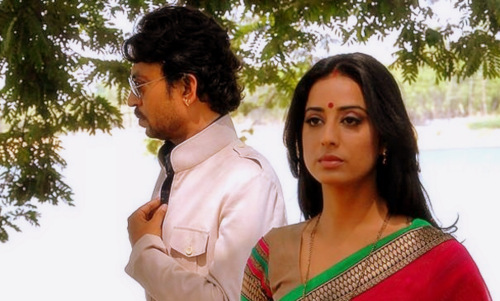
What do audiences take home from films like Saheb Biwi Aur Gangster Returns? I, for one, came away with a headache. Tigmanshu Dhulia perhaps wanted to critique contemporary India’s fungible moralities and the absence of valour even in blue-blooded descendants of erstwhile princely states (of course he'd already done so effectively enough in Part 1, but still...). In a superb tragicomic scene the gangster (Irrfan Khan) struggles with a rusty knife to pledge his blood towards restoring family honour before the pockmarked bust of his ancestor. It’s unambiguous irony––among a few such clever moments––but for those who’ve seen the film, it’s also a dead giveaway that the SBAG franchise may even spawn a third edition, particularly if reports of an encouraging box-office opening are true. In a newspaper interview published last weekend Dhulia confessed that he only made the film for commercial reasons.
By contrast, after processing the initial few reels of Sahib Bibi Aur Ghulam (Dhulia’s film is a subversion of the same theme––or at least the first one was) well-wishers cautioned its producer, Guru Dutt, against going ahead with the project because they feared it would be a commercial disaster. Dutt was unfazed; he liked what he saw and thought it had an intrinsic value. The naysayers were proved right in the short run and Sahib Bibi was a box-office disaster. But 50 years hence, along with Pyaasa and Kaagaz Ke Phool, it’s a vital contributor to Dutt’s steadily crystallising reputation as one of India’s finest filmmakers, if only posthumously. In 50 years Tigmanshu Dhulia may also have crossed over, but why should the longevity of his films trouble him in the first place?
In an interview to the American Film Institute in 1972, celebrated Scandinavian actress Liv Ullmann expresses her distress on watching Francis Ford Coppola’s The Godfather which released that year. “I saw The Godfather the other day and hated it. I am shocked that the critics and everybody says that it is so marvellous. The audience applauded when the more fantastic murders were shown. I don’t like that. I don’t see the purpose.” In the West, there have been extensive studies on the depiction of violence in cinema and its impact on the audience. But mere common sense suggests that the effect could only be adverse and counterproductive (assuming filmmakers employ wanton violence or wantonness of any other kind only to spread the message of peace and humanity in the first place).
In SBAG Returns, all the principal characters (and the peripheral ones too) are self-serving opportunists of constantly shifting loyalties and given to casual violence––like the only residue of aristocracy that trickled down was palace intrigue, back-stabbing and unmitigated lust. The Hindu’s Sudhish Kamath rightly points out in his review, “Saheb Biwi Aur Gangster Returns feels and sounds more like an ethnic version of Race 2 with a score borrowed from The Attacks of 26/11.” That’s the fundamental problem with franchise films anywhere in the world. The follow-ups have to replicate the template regardless of whether or not there are any fresh ideas left to explore. As the SBAG Returns trailer brazenly declares, “Not all stories end where they should”.
The cinema of Anurag Kashyap and Dhulia in particular, but almost the entire crop of recent realist films, has a disheartening effect. Back in the ‘70s when the angry young man raged against the establishment and the parallel cinema relentlessly condemned exploitation of the poorest sections, either sensibility had enough room for individual righteousness and heroism. Also, there was an entire genre of middle-cinema––gracious urban comedies and gentle love stories––to offset the despondent mood.
Today however, the scenario is of abject despair. There is no middle cinema, the comedies are scraping the bottom of the vessel and nobody’s angry against the system because everyone has already enlisted. So that, when Dibakar Banerjee’s Shanghai throws up flawed but determined characters with an iota of grit and conscience, it suddenly seems extraordinary.
But generally speaking we are pushing the envelope further into the heart of darkness. Let’s explore just how inhuman humanity can get. As Kashyap’s That Girl In Yellow Boots demonstrates, everything has been irrevocably soiled, including filial relations. Which may in fact not be entirely untrue, yet, wouldn’t it be heartening, nay life affirming, to see a kindly father figure? Yes, Naseeruddin Shah's character is a stand-in, but it brings me to the next question, that of subtlety.
In a cinema that’s traditionally seeped in melodrama and declamatory, larger-than-life expression, what impact can nuances have on the audience at large? How often have we seen viewers hooting in the very places that the filmmaker perhaps intended for them to pause and introspect? A scene towards the end of The Dirty Picture where Silk flees the blue film shoot and is staggering on the streets seeing her reflection in puddles and mirrors––a crucial moment in the character’s journey as she looks back remorsefully––was greeted with guffaws at the single screen where I watched the film. The audience had no patience for her tragedy. They wanted her back in the bathtub (Dhulia puts his heroine in the bathtub too) or fake an orgasm on screen to their gratification.
There's a similar problem with Banerjee’s Love Sex Aur Dhokha, clearly intended to caution us against heedless submission to a voyeuristic culture. By packaging its message in disturbing digital (and hence life-like) images of body hacking and pornography, it left the audience free to choose whether to consume the film with outrage or indulgence. Similarly, in SBAG Returns, Dhulia’s subtle insights into the debauchery of its ensemble are liable to be misconstrued as a version of latter-day heroism, what with Khan swaggering in slow motion proclaiming, “Hamaari toh gaali par bhi taali padti hai”––a sure shot crowed-pleaser.
Only occasionally have filmmakers employed restrain in depicting depravity and in these cases the message is always unambiguous. The best example that comes to mind is a horrifying scene in Govind Nihalani’s Aakrosh, filmed entirely from the protagonist Lahnya’s (Om Puri) point-of-view as he stands outside the shack where so-called pillars of society are brutally raping his wife (Smita Patil). As the woman’s anguished cries pierce the night, the terror and helplessness in Lahnya’s eyes leaves us numb––we become party to his suffering because we can only see what he can. There is absolutely no room for doubt about the filmmaker’s intention.
A lesson our new-age mavericks must learn for the sake of restoring sanity and humanity to our cinema.


Comments