


 REVIEW: Goynar Baksho
THE GHOST HAS THE LAST LAUGH
There’s something intimate and otherworldly about Rashmoni’s (Moushumi Chatterjee) wooden jewellery box. She guards it with her life and grudgingly doles out little pieces of intricate gold to new brides in the household with a bitter word thrown in to underline her disapproval. She keeps meticulous records of her cherished possessions and secretly tries them out in the confines of her chamber. They represent everything her life may have been if fate (or more accurately, the force of patriarchy) hadn’t played its cruel hand. Married at 11 to a much older man, widowed at 12, she has lived in deprivation and neglect ever since, her long tresses cruelly chopped off, her desires trampled even before she discovered them.
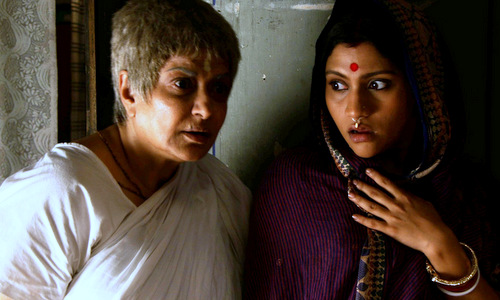
Rashmoni is angry with a tradition which allows the decadent men of the fading zamindari to idle their hours away fishing in the pond or playing chess lounging in the sun––none of them have worked for even a day we’re told, and they can’t change their ways now just because times have changed and their fortunes dwindled to a point where they must sell their heirlooms to survive. Hypocritical morality allows them to keep mistresses and come back to their wives at night sanctimonious as ever, but poor Rashmoni hasn’t so much as tasted fish in all these years!
Into this milieu arrives a timid new bride, Somlata (Konkona Sen Sharma). She stammers when flustered and is bewildered by the atmosphere of her new home and particularly the rancour Rashmoni (or Pishima as she addresses her) exhibits. Yet it’s she who stumbles upon the old woman’s sudden death and is confronted with her spirit (Moushumi seems genuinely delighted about rising from the dead with a bright ghostly aura around her) instructing her to hide the box from the family and threatening her with dire consequences if she fails to do so.
Set in Bengal of the post-independence years and leading up to the formation of Bangladesh in 1971 (the family originally hails from Faridpur in the East and has had to leave behind large tracts of land when they relocated) Aparna Sen’s Goynar Baksho is a scintillating adaptation of Shirshendu Mukhopadhyay’s novel. At its heart is the jewellery box, a symbol of repression and source of liberation for three women across generations. It’s also a social document almost as powerful in some ways as Guru Dutt’s Sahib Bibi Aur Ghulam––the crumbling haveli, it’s faded walls, chipped chandeliers and ticking clocks bear the same sense of loss and foreboding. There’s a resonance of Sen’s earlier masterpiece Paromitar Ek Din too in the kinship of women struggling to hold together a once affluent but fractured family while trying to fulfil themselves in small ways.
But unlike both films, the mood here is doggedly cheerful and uplifting so that the protagonists don’t seem helpless for even a minute, instead using wit and instinct to set things right. Even Rashmoni's rants are often laced with biting humour. You see her ghostly presence perched on a ladder or on shelves, hookah in hand, laughing heartily at the family’s idiocy. And how she instigates Somlata by feeding her gossip, or orchestrating an earthquake in the kitchen!
The younger woman is wise in her own right and doesn’t take long to figure out that her foolish husband––who she refers to as “a lion among men”––is unlikely to do anything unless she nudges him on. Chandan is the kind who can’t even commit suicide without making a mess of it (this scene is uproariously funny and Saswata is such a fine actor to make the character endearing despite his stupidity!) so that when his wife asks him if he believes in ghosts, he starts shivering with fright and promptly jumps into her arms.
As the father and brother-in-law predictably oppose Somlata’s decision to start a business, a pithy rap song lampoons them. The music (Debojyoti Mishra) is uniformly good, including the title sequence with its poetic idiom and brilliant black & white animation which encapsulates the film’s theme and an evocative melody rendered by Shubha Mudgal to signal the stirrings of Somlata’s heart.
Sen doesn’t step out of the narrative to highlight her characters’ dilemmas but Rashmoni must still tell her story so that Somlata may learn from it. The flashback is heart-rending even though Srabanti Biswas who plays the younger Rashmoni and later, Somlata’s daughter Chaitali, is the weakest link in the ensemble. For that matter, the entire third act seems disengaged from the principal narrative and goes off the rails threatening to bring the house down with its inconsistency. Barring a scene that has Rashmoni and Chaitali sharing a smoke together on the terrace there’s little to hold interest and the denouement isn’t satisfactory even though ends are tied up neatly.
But that doesn’t dilute the overall impact of this wondrous film. Even if the special effects look tacky in places––one blooming tree in particular is a horrid eyesore as is a scooter ride Rashmoni takes with her grand niece. Its magical quality emerges instead, from the source material itself and is enhanced by two magnificent performances. Moushumi Chatterjee, who one never took seriously as an actress, is such a revelation you want to just reach out and kiss her hand! Konkona Sen Sharma now has back-to-back winners in Ek Thi Daayan and Goynar Baksho and really, I’d watch virtually any film featuring her (with the notable exception of Atithi Tum Kab Jaaoge).
Most of all, it's a pleasure to see women bonding on screen without going into weepy puddles and stealthily pushing boundaries in the process. If nothing else, you’re sure to get your weekly dose of laughter.


Comments