


 ESSAY: The Elder Scrolls
LIFE, DEATH AND EVERYTHING IN BETWEEN
We often describe our films as ‘melodramatic’, literally meaning a combination of melody and drama––a heightened representation of emotional states, achieving climax and offering collective catharsis to an audience. Melodrama synthesises social criticism with mythical archetypes thereby enabling the viewers (diverse sections of them, as another essential ingredient of this genre is the near absence of psychological depth) to see the follies of men and institutions combined with the triumph of virtue and punishment of vice. The audience’s involvement with the characters’ journey is critical to the success of the genre.
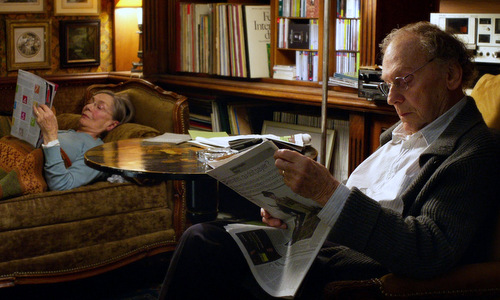
European cinema has a different approach from Hindi movies typically defined by larger-than-life heroes, booming rhetoric and, at least in the cases of our best films, the use of songs and music. Which isn’t to say that their filmmakers are entirely oblivious to this style. Jacques Audiard’s recent film Rust And Bone is an excellent French melodrama about the unusual love story of an amputee and an out-of-luck kick boxer (hope Sanjay Bhansali never hears of it).
But Michael Haneke is as far removed from melodramatic traditions as can be. Despite the shock value of most of his narratives––often a harsh indictment of Hollywood cinema and the complicity of the spectator in cinematic violence––they are clinical and squeezed of all emotion even in extreme situations. Haneke has sometimes been accused of being cynical about the human condition, a charge I find ridiculous. Yet, Amour comes as a pleasant surprise and is, in many ways, a complete departure from his previous work, notably Funny Games, Cache, The Piano Teacher and The White Ribbon.
It left me terribly moved and restless for days despite its stark un-sentimentality and dogged refusal to exploit its characters. Even in scenes delineating the decline of the female protagonist Anne’s (Emmanuelle Riva) health, the camera doesn’t gaze at her frail, vulnerable, wrinkled body in compromising ways as many directors would have been tempted to do, if only to amplify the import of her suffering. Haneke respects actors and audiences, expecting them to be equal and willing participants in the narration and absorption of his devastating tale about the inevitability and sheer humiliation of old age, its attendant complications and their impact on the lives of people who have to watch loved ones suffering from suffocatingly close quarters.
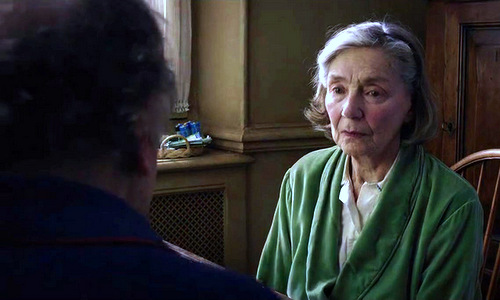
There are several thematic elements and scenes in Amour which lend so readily to melodrama, it would take only an exceptional filmmaker to steer clear of the temptation. Like when Anne blanks out for a few minutes and her husband George (Jean-Louis Trintignant) tries to revive her. His panic isn’t evident either in his voice or actions, but when he wets a dishcloth to apply cold water to her forehead and neck, he leaves the tap running and forgets to turn it off even as he goes past it to the bedroom to change and call for help.
Soon after Anne returns from hospital following a stroke and a failed surgery that leaves her paralysed and wheel chair bound, her former student whose piano recital they attended at the beginning of the film pays them a visit. The student’s awkwardness when faced with the disability of his favourite teacher and her firm refusal to allow the conversation to descend into a sentimental appraisal of her condition is conveyed through his body language and her polite but firm insistence they change the subject.
Haneke adopts a similar approach to their relationship with their daughter Eva (Isabelle Huppert) who visits them occasionally but isn’t in a position to offer anything beyond the hollow advice that George should transfer Anne to a hospice because he can’t possibly manage her at home forever. But the husband-wife have a pact and he has promised never to send her away; however hard it proves to fulfil his promise, he trudges on without shedding tears or getting overly irritable even though he too is old and tired.
That’s heroism and that’s love.
George doesn’t judge Eva for her inability to help them. But her visits start bothering him because he feels tired facing the same inquisitional tone and barrage of helpless recriminations. The daughter transfers her guilt onto the father, blaming his stubbornness for the situation. They argue, but he doesn’t relent and one day when she drops in he locks the door to Anne’s room to deny Eva a glimpse of her mother. This isn’t cruelty but a measure of his despair and also perhaps the only way he can chastise her insensitivity. Yet he isn’t bitter when he says, “You have your life and we have ours,” asking her to let them be.
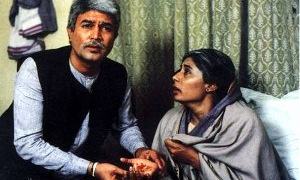
It is in this relationship that the contrast with Hindi cinema is most glaring. How often have we seen the drama centre on the relationship between sacrificing parents and neglectful children who eventually get their comeuppance for not caring enough? A couple of Rajesh Khanna melodramas of the ‘80s, Avatar and Amrit, come to mind. Both highly charged in their exposition and reasonably successful at the box office, gave a brief lease of life to the fading superstar and firmly established the genre of the ever-suffering parents vs. the callous kids (always played by relatively unknown actors so as not to confuse the audience’s sympathies) and later exploited to great commercial success in Ravi Chopra’s Baghban with another former superstar pair, Amitabh Bachchan and Hema Malini playing the afflicted couple.
But nobody on the Hindi screen has dared look as old and frail as Trintignant and Riva. It would be scandalous! Both actors are well over 80 and in a chilling way, potentially in the line of Time’s bending sickle's compass so that every crease on their faces and the weariness in their bodies seems painfully authentic. You might have the odd Zohra Sehgal or A.K. Hangal in supporting parts but nobody writes films for them and if at all our youth-obsessed cinema momentarily shifts its gaze to geriatrics they have to be played by younger stars or older ones trying to cheat time with cosmetic aids and hair weaves.
The only notable exception that comes to mind is M.S. Sathyu’s Garm Hawa where Balraj Sahni portrays a heartbreaking character in post-Partition Agra unable to abandon his home for the alien shores of the newly formed Pakistan where much of his family has migrated. But Garm Hawa isn’t as much about old age as it is about the confusion and helplessness of an individual caught in the swirl of political events that impinge on his trivial life in very real, destructive ways. Yet Sahni was old and he was the film’s protagonist, and that itself was such a novelty!
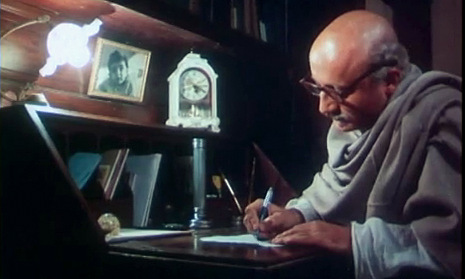
After a second viewing of Amour, I revisited Mahesh Bhatt’s 1985 melodrama, Saransh, the rare Hindi film that focuses on an aged couple without making family discord and insensitive children the central refrain. Characteristically, the couple isn’t played by old actors but by very young people––Anupam Kher made his screen debut with this film at the age of 26, while Rohini Hattangadi, fresh from her success as Kasturba in Sir Richard Attenborough’s Gandhi, was only in her mid-‘30s. Both are very good actors, but can their studied performances match Trintignant and Riva’s lived experiences? Most unlikely.
To make a digression, Sir Richard recently sold his plush London house for a large sum of money and checked into a home for the aged––apparently catering to theatre professionals––with his actress wife Sheila Sim. Admittedly it’s easier for people to avail of sanatoriums in the West given that comfortable facilities of the kind that are still a distant dream in India. But I occasionally visit a reasonably well-managed old age home near Mumbai and find that many of the elderly folk residing there are bitter about being dumped by their families and long to be home, echoing the cinematic script.
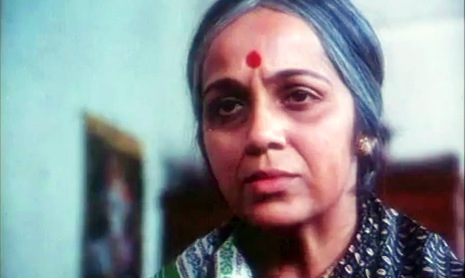
Back to Saransh, despite its curious casting choices and extremely melodramatic treatment, it delivers a compassionate reflection of the elderly in middle-class neighbourhoods like Shivaji Park, an area I know intimately, having grown up there with my grandparents not very different in appearance or values from the protagonists of Saransh––the man, B.V. Pradhan, a retired principal and his wife Parvati, a nursery school teacher. The couple has recently lost their only son to a violent crime in the US and are struggling to come to terms with it.
In some ways Pradhan is a vigilante hero, but what adds complexity to the character is his physical frailty, coupled with acute loneliness and a desire to end his life in the wake of the tragedy. Unlike his wife, who seeks solace in religion and blind faith, the man has nothing to hold on to and it is he who must face the apathy of the world more immediately, be it to collect his son’s ashes from the bureaucratic annals of the customs office or seek employment at a late age for sustenance. The latter of course is a classic melodramatic device––it’s hard to believe that a retired principal has no pension or savings to fall back on and was entirely dependant on the money his son sent him, which has now dried up.
It is with the arrival of Sujata (Soni Razdan) a young actress who comes to stay with them as a paying guest, that the plot thickens and Pradhan must snap out of his depression to protect her from the villainous machinations of a local politician whose son she loves. This aspect of the screenplay is manufactured to play upon the audience’s emotions and hence the catharsis is equally contrived. Yet Saransh makes its point quite well. Old age is cruel but unavoidable––and likely accompanied by the death of loved ones, sickness or loneliness, and facing its challenges with dignity (as Pradhan does, overcoming limitations of plot) is perhaps the noblest culmination of a life spent negotiating the chaos of the material world.
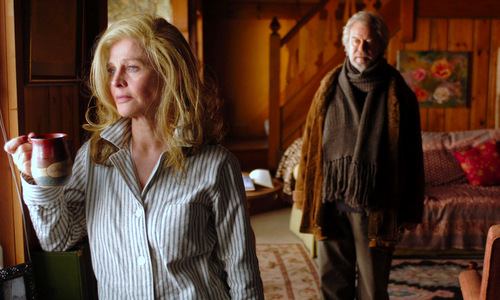
In Sarah Polley’s Canadian gem Away From Her, a long-term couple are faced with the impossible choice of sending the wife to a specialised home after she’s diagnosed with Alzheimer’s. The husband, Grant (Gordon Pinsent), procrastinates because the idea of living without her is too painful to bear. It is Fiona (Julie Christie) who takes the decision as she tells him, “All we can aspire for in this situation is a little bit of grace” before packing herself off with a brave smile on her face. With minimum fuss the screenplay brings the intensity of their mutual love to the fore, but doesn’t baulk at addressing the disappointments of a relationship that’s had its share of bumpy turns.
Both Amour and Away From Her use the poignancy of the narrative and charged performances from a sterling cast to deliver the payload. But it doesn’t necessarily take the sense of a lifelong journey to convey emotions or even the overstatement routinely employed by Hindi cinema. I am still haunted by the image of an old lady sitting on a stool staring into nothingness in Kiran Rao’s Dhobi Ghat. This character has no identity in the film and is literally a fleeting image one of the protagonists glimpses as he passes by her door. She doesn’t speak or betray any feeling on her face.
Only her vacant eyes scream out in anguish.


Comments