 DOCUMENTARY: An American In Madras
A PEEK INTO HISTORY
India doesn’t have a particularly good record at preserving film history. Shivendra Singh Dungarpur’s insightful biography of legendary archivist P K Nair, Celluloid Man (2012) chronicles how Ardeshir Irani’s son sold the film negative of the first Hindi talkie Alam Ara (1931) as scrap. In one of the film’s most dramatic moments, neglected reels of old films cry out in the vein of that anguished climactic call by Meghe Dhaka Tara’s Neeta—“I want to live”!
Fortunately when FTII-trained writer-filmmaker Karan Bali stumbled upon a man called Ellis R Dungan who came from America in the 1930s and worked in the Tamil film industry for 15 years, there was enough archival material at hand to piece together his fascinating journey. Thanks to Dungan’s American roots Bali could trace his autobiography, photographs and documentary footage from material he’d donated to the West Virginia State Archives.
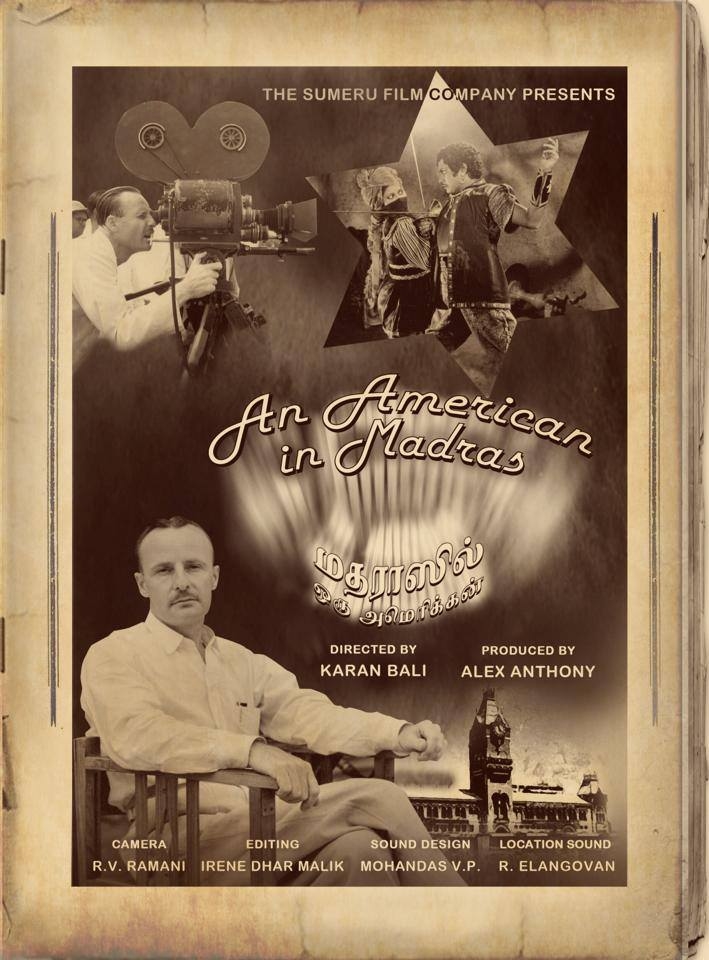
A poster for the new documentary in the style of the vintage cinema Dungan was associated with.
He also managed to source half-a-dozen films, including one from a Malaysian source and the others from the National Film Archives of India (NFAI). Says Bali, “I’d seen his bilingual Meera (1945/47) starring M S Subbulakshmi on Doordarshan and read about him in The Encyclopaedia of Indian Cinema. But it was while researching for a profile on my website that I realised one could do more.”
There’s of course the exotic value of a white man making Tamil films without knowing anything about the language or the culture. (Bali himself has only a functional understanding of Tamil, which makes his obsession with Dungan equally intriguing.) But his contribution towards replacing the theatrical style prevalent at the time with a more cinematic visual design — including close-ups, tracking shots and even a day-for-night sequence — actually puts his legacy in perspective. “In Ambikapathy (1937), when the protagonist is about to be executed by the king, he had a visual flashback to depict his life flashing before his eyes. To show the spread of Meera’s fame, he shot her singing in the temple followed by a montage of people all over the country singing her songs at work. Such things had never been done before,” Bali observes.
Singer M S Subbulakshmi with Dungan during the making of Meera
Equally interesting is his depiction of women. As filmmaker-scholar Uma Vangal suggests, “The women in Dungan’s films were always bold and seized control of their own fates.” So that in the Romeo & Juliet-type romance, Ambikapathy, it’s the woman who writes the first love letter; in Sakuntalai (1940), she vents her anger on King Dushyant; in Manthiri Kumari, Madhuri Devi, who also played the protagonist in Ponmudi (1949), goes as far as to shove her vile husband off a cliff.
Though not all his attempts at pushing boundaries succeeded. Ponmudi, his boldest film, failed at the box-office and was criticised for being ‘vulgar’. It’s amusing to see C M Muthu (he worked as a make-up assistant on Sakuntalai and Meera) look into the camera with mischievous eyes saying, “Very nice and heavy love scenes. Have you seen them?”
Bali captures Dungan’s adventurous spirit quite vividly through photographs of his travels in Spain and Paris before returning to the US to study cinematography at the University of Southern California; then taking an impromptu decision to come to India to make movies on the invitation of his classmate M L Tandon whose father was setting up a film studio. And although he returned to the US in 1950, he would keep coming back as an expert consultant on various American productions trying to capture exotic India in works like Harry Black And The Tiger (1958) for which he directed the tiger sequences and Tarzan Goes To India (1962) in which he served as the second unit producer. Earlier, he’d travelled the length and breadth of the country as an official photographer for the Madras government during World War II and covered key historic moments including Gandhi’s funeral. He also made several documentaries about life in India.
A still from 1958's The Big Hunt, in which Dungan made his North American acting debut.
Just under 80 minutes long and featuring interviews from various personalities associated with Tamil cinema including Kamal Haasan and filmmaker-scholar K. Hariharan, apart from Dungan’s personal friend Rochelle Shah and Dr Radha Viswanathan who acted in Sakuntalai and Meera, An American In Madras, which will have its first screening in Chennai on December 1st (Dungan’s death anniversary), is a rewarding peek into a chapter in Tamil film history.


Comments