


 REVIEW: Dabangg (3)
B-MOVIE KA BAAP
You don't expect high entertainment when you walk into a film like Dabangg. You want Bollywood's most predictable cliches packaged to invoke memories of stylish stars regaling you with their trademark histrionics. The hero must look into the camera and talk to you like you're privy to his inside track. The film has to have five songs, five action scenes, three emotionally charged moments, a couple of romantic interludes and plot that somehow strings all these things together. Abhinav Singh Kashyap's debut delivers all of the above, and does so in style.
What separates Dabangg from most B-movies is it's all done smartly and without too many deviations from the narrative. The film language is far more sophisticated than average Hindi movies. It's easy to pick a cliche, but very challenging to use it intelligently. As a case in point see any of the recent films that have emerged from Yashraj Films or Dharma Productions that relentlessly parody both banners' previous work, but never really manage to get it right.
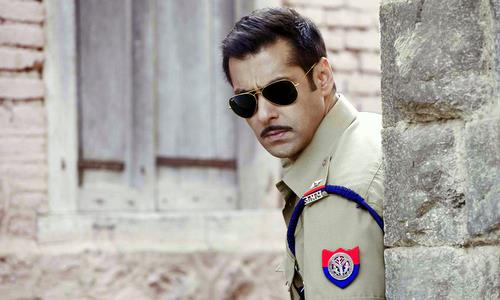
In this film, Salman Khan plays Salman Khan. He knows he has to look lean and fit, strut about stylishly, crack corny jokes and shamelessly play to the gallery. He's Chulbul Pandey the corrupt UP cop with a heart of gold -- you can't be an honest cop on the Indian screen anymore. He loves his mother (Dimple Kapadia, disastrously miscast) hates his step-father (Vinod Khanna) and doesn't particularly like his dimwit half-brother Makkhi (Arbaaz Khan). The antagonist Chhedi (Sonu Sood, with an even better body than Salman) is equally comical and Sood hams hysterically.
Somewhere between their face-off is a love story involving a strong and silent type potter (Sonakshi Sinha, better than most Bollywood glam dolls and a happy throwback to the '70s heroine), a politician with his own agenda (Anupam Kher) and assorted other minor characters of little consequence. The background score serves up spaghetti western guitar pieces, the action derives from Southern-style gravity-defying stunts (Salman's number with his Ray Bans is so typically Rajnikant!) , and the dialect, locations and set design are properly placed in Uttar Pradesh instead of the standard nowhereland of Hindi cinema.
The good part is, despite its overt machismo and hierarchical stereotypes, there isn't an vulgar commodification of women (barring the token item song "Munni badnam hui", without which any film set in the Hindi heartland is incomplete). The film doesn't look tacky and the feeling it evokes is that of sinful pleasure.
Most of all, it doesn't, for even a moment, pretend to be anything that it is not. Rather watch a Dabangg than suffer all the Luv Storys and Aishas of the hypocritical, upper-crust, feel-good multiplex cinema.

 Google Talk: filmimpressionsgroup
 Twitter: filmimpressions


Comments