


 Google Talk: filmimpressionsgroup
 Twitter: filmimpressions


 ESSAY: Women Who Have Jobs And Other Troublesome Pursuits (Part 1)
By Joyojeet Pal
In 1973, K Balachander made Arangetram. In the film, the eldest daughter of a rural orthodox Brahmin family moves to the city to get a job. She is forced by circumstances to earn a living as a prostitute, but works her family out of poverty. In 2000, Rajiv Menon made Kandukondain Kandukondain. A rural Brahmin family is likewise impoverished, and the eldest daughter must negotiate life in a city to earn a living. She gets a job as a software engineer, and works her family out of poverty.
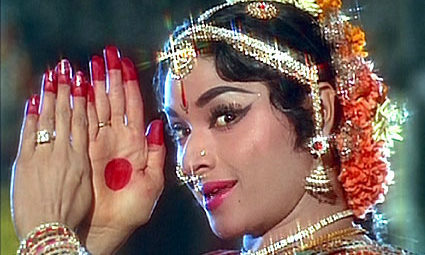
A lot has happened in three decades. Much of the software and BPO sector in Chennai is comprised of women, many of who are from the hinterland, and probably the first in their families to get jobs. And yet for a number of husbands in Tamil Nadu, proclaiming proudly that their wives are ‘houswives’ – ie they do not need to work, continues to be a source of manly pride. Arangetram and Kandukondain have one important factor in common. The reason the woman works is that the man has in some form, failed. The father, brother, or husband can be dead, drunk, incompetent, or pure evil. Save for these, there is little good reason why a respectable woman, especially a middle-class woman, crosses the threshold of the home and ventures out into the nasty space of a man’s domain on screen.
Historically, there have been two conflicting forces in what defines a woman’s role in profession – tradition, and class. We look briefly at both. Tradition: between Goddesses and Vamps One of the most important symbolic heroines in Tamil has been the mythological Kannagi – the long-suffering virtuous wife of a wayward husband in the 5th century epic Silappatikaram. When provoked, Kannagi uses righteous vengeful anger to destroy the entire city of Madurai. The Kannagi/Durga prototype that plays a destroyer role has been a consistent element of wronged womanhood on Tamil screen. At the most obvious level, this includes women with jobs such as female police officers, but at the symbolic level, this includes women who fit the broader persona of Kannagi, irrespective of the jobs they hold.
Thus, this would includes a range of female protagonists from the spiteful governess played by Sridevi in Moondru Mudichu who marries her obsessive tormentor’s father in a brooding act of retribution, to Nanditha Das who goes back into a war zone in Vavuniya for her lost husband and becomes an LTTE commander in Kannathil Mutthamitaal to the incensed journalist Madhavi from Nirabaradhi who kills rapists by night to avenge her outrage (symbolically, she walks past the Kannagi statue by the Marina beach before she bumps off one of her tormentors).
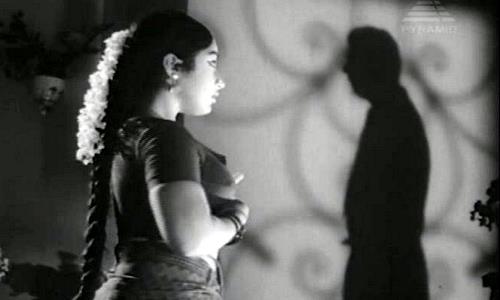
For such a woman, the tension between her righteous vengeance and the breach of law frequently ends with the slight inconvenience of death. At the end of Nirabaradhi, the heroine must commit suicide, not just because she has killed a bunch of people, but also because she has lost virginity in the process, and therefore considers herself unworthy of the hero – a police inspector. Had she not moved to the city for a job, none of this need have happened.
The second traditional role is what may fall under the ‘Parvathiamma’ or classic mother categorization of work. In this, we see the range of caregivers such as doctors, nurses, or domestic childcare.
The gold standard for motherhood in Tamil Cinema, is of course the honour of playing MGR’s mother. One of the few times MGR’s screen mother has had a job was in Deiva Thai (Mother Goddess). Here, the father (Ashokan) is mistaken for dead, and the mother (Pandari Bai) raises her son working as a nurse, a job that is socially respectable, and aligned with domesticity. Conveniently, as a widow, she can wear the white nurse outfit as well. The motherliness factor works both ways – just as the job is worthy of a woman, a good Tamil woman has the appropriate trappings for forwarding the medical profession as a whole, because of her inherent qualities of generosity and selflessness.
In the prominent nurse/doctor caper Paalum Pazhamum (1961), Sivaji Ganesan plays a doctor researching a cure for cancer, aided by nurse/romantic interest Saroja Devi. When she is afflicted by tuberculosis, Sivaji turns his attention towards her instead of at his socially relevant research. In an ultimate act of self sacrifice, the nurse takes off and disappears so that his work won’t get affected. In doing so, the character emphasizes that while her job is both honourable and useful to society, she is instinctively driven to sacrifice herself and her job for the larger social good.
By the 70s and 80s, as lady doctors themselves became more publicly visible in Tamil Nadu, several films including Puthiya Mugan and Vetri Vizha featured female actresses as doctors. The third symbolic heroine is the goddess Saraswathi who represents knowledge and the arts. Thus school teachers such as Sumathi (Vijayalakshmi) from Teacher Amma represent the values of knowledge but also the motherly values of humility, sacrifice, and the ability to suffer with a smile. She gives up the man she loves for a friend, and then takes on the responsibility of an orphan, despite the grief of social stigma. In being both the caregiver and the upholder of culture, the teacher represents an idealized Tamil womanhood.
In Bharatiraja’s Kadhalora Kavithaigal, we see this therapeutic femininity, as an urbane teacher (Rekha) works to slowly transform the former jailbird and village brute Chinappa (Sathyaraj) to a kind and sociable man. In the process, he becomes her protector, and she his moral mirror, thus reinforcing that neither is complete without the other. The Saraswathi personification extends to the artist – thus the Carnatic singer/performer or Bharatnatyam dancer. Most screen depictions of female classical musicians or performers tend to be demure women and exemplify a true Tamilness, such as Padmini in Thillana Mohanambal or Suhasini in Sindhu Bhairavi who is an intellectual (somewhat in the vein of a the mythological Madhavi) and is portrayed as able to bridge the gap across the exclusivity of art, which she does by translating Carnatic music into understandable Tamil. This in turn also touches on an important political theme of Tamil cinema and politics – the accessibility of art, culture, and language outside of a social/cultural/caste elite. The use of classical music as an indicator for the virtue of a girl is by no means passé, two of the biggest hits in the last decade – Chandramukhi and Anniyan both had female protagonists that were classical music teachers.
The skills involved in dancing cabaret may be comparable (and it may also be commercially both more valuable to the film), but the dancer has by no means the same legitimacy as the Saraswathi of classical artists. The ‘western’ performer – dancer, actress, or model, irrespective of evil intent, makes a living by her feminine wiles. Thus, her audience is men, and risks are consequently inherent in being exposed to a stimulated masculinity. The female performer is thus portrayed as ‘rightly at risk’ from her audience and colleagues alike. In Viduthalai, Rajnikant’s dancer girlfriend Madhavi is frequently approached by lecherous men who take liberties since she is a dancer, and it takes the alpha male to protect her from the men so long as she continues the occupation.
In Duet Priya, and Puthu Puthu Arthangal, the risk is closer to home, from co-workers. Choreographer Meenakshi in Duet has to contend with the advances of a hostile director, in Priya actress Sridevi gets exploited by her manager, roughly the same fate as dancer Sithara in Pudhu Pudhu Arthangal. In each case, the woman performer is eventually rescued from her situation by another man. The contrast between the ‘Tamilness’ of a classical dancer and the ‘foreign’ nature of a western dancer are fundamentally irreconcilable. In Parthiban’s Ivan, the classical singer Soundarya is chaste, soft spoken and strives for musical perfection, whereas the other woman vying for the hero, Meena, is loud and boorish, wears bright lipstick, tells lies so the hero will marry her, and most importantly – she loves Chiranjeevi (ironically, a good woman in a Tamil film rarely watches films) and speaks Tamil with a smattering of Telugu, instantly puncturing any claim to purity.
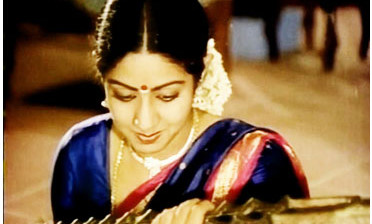
The performer can be a source of lustful temptation and consequently a thorn in the path of a virtuous life even when the impetus is primarily that of a wayward man. Thus in Meendum Kokila, lawyer Kamal Haasan toys with the idea of an affair with movie star Deepa. His wife, Sridevi, possesses all the artifacts of tradition – plays classical music, dresses conservatively, and the actress on the other hand is a corrupter just by being herself. In a telling scene, the husband tries to get his wife to recreate at home the physical moves of the actress’ dance routines, which fail, implying that the fantasy played out by a western performer is fundamentally incompatible with the good wife, even behind closed doors.
In MGR’s Ulagam Sutrum Vaaliban, traditional (but poor) Tamil girl Ratna (Chandrakala), takes a loan and a job abroad as a dancer at a hotel to support her family. In a song sequence, her dance starts at Bharatnatyam, but with each dress change gets racier. Eventually, she has to dress down to a skimpy outfit, which she refuses. The hotel manager attacks her, and points at a white woman in a bikini, telling her he must look like her, to which she responds, “I have left Tamil Nadu to earn a living, but I won’t bring disgrace to my nation.” As would be the case, this is a situation for a man’s intervention, and MGR conveniently appears to pay off her loan and saves her.
The western dance routine is also invoked at times to reinforce artistic superiority. In several films, there is a face-off between western dance and classical or folk dance. In such cases, like in Puthiya Bhoomi (1968) where a sprightly Jayalalitha faces off her swinging nemesis, the western variant will always be defeated. Through much of the 60s and early 70s, films featuring a ‘western dance’ would frequently be accompanied by fair skinned Anglo-Indian extras, thus emphasizing the alienation of such scenarios from what is authentically Tamil (this is of course disturbing in itself, in terms of the potential suggestion of Anglo-Indians as incompatible with Tamilness).
In Panam Padaithavan (1965), while his fiancée Sowcar Janaki is dancing to a western tune with another man, MGR sings an allegorical song “Can people do as they wish, can they forget the path from which they came.”


Comments