


 INTERVIEW: Anand Tiwari
CAN PLAY ANYTHING (EVEN A LAMP-POST)
An interview with one of contemporary Indian theatre's most versatile young actors, who has worked in plays like Sunil Shanbag's Dreams of Taleem, the AkVarious production of All About My Mother, and Rage Theatre's One On One.
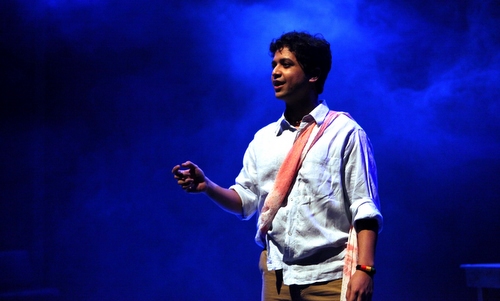
There is a lot of creative interchange taking place these days in theatre, for instance, actors working across different companies, which may not have happened a few years back. You are one of those actors who’ve worked with a diverse set of directors. How did this opening up of talent come about?
I think, about 5-6 years ago, the situation in Mumbai theatre was that groups had become very insular, but then there were initiatives like Writer’s Block from Rage where they got directors and writers from outside to collaborate and create new works. So a lot of connections began. At the same time, a lot of groups started dissolving and people started looking for work outside. A lot of talent suddenly went into that open pool and people could approach anybody and actors could work with anyone they chose.
Was there an unsaid rule that they couldn’t in the past?
I think there was. I wasn’t part of any group as such. I used to work with Etienne Coutinho and his company Work In Progress. We did events, and corporate theatre etc. When I left my job to do acting full time, somehow that was the time when this great exchange or whatever was happening, and it was a free for all. Everybody was working with everybody. I was fortunate enough to be around when I could work with ‘n’ number of directors, and that’s what I want to do. I don’t want to work only with one person, and I don’t think theatre exists only in one form. It should be open to anybody and everybody.
Do you think Indian theatre is in perfect health?
To be very honest, I think theatre needs to take itself quite seriously as an entertainment form.
But not in a self-important way?
Not at all. What I’m trying to say is, if an audience is paying Rs 100 to Rs 300 to come, and they aren’t going to the cinema, and are missing out on the glitz, the glamour, the foreign locations, the music or the edits, and are instead spending that time at a play, I think we should push ourselves to give them content that is worth their time and yes, there is some very good content in theatre but I think it shouldn’t become a stepping stone for something else. It should exist for what it is. You can do films, and you can do theatre, but theatre should be a priority when you do theatre or you shouldn’t do theatre at all.
What’s your opinion of English language theatre in India?
I think it’s getting better. We are now accepting the way we speak English, accepting the way we relate to the language. For instance, the way you and I are interacting right now without being conscious about it, in the same way I shouldn’t go on stage and become a Ted…
…you can have a kind of bol-chaal kind of English.
You could also, but I’m saying don’t just get stuck just with say, Shakespearean theatre, or Shaw. Use what you have also.
In One on One, you have three roles, that of an IAS officer, a lamp post…
In the third one called Abudaana, I play a production controller of sorts who’s working in Bombay but is actually from Allahabad, and he’s married to the character played by Preetika Chawla. They’re both not originally from Bombay. We talk of experiences of people from the north who come to the city..
…so in theatre in many ways you have the opportunity, or the space to display a good range of performing ability. In cinema, there is the danger of being typecast…
In films, I think, we don’t really get the major roles. Probably because I don’t have the right connections…
..but you’ve managed to get a good bunch of diverse roles this past year… like in Udaan?
I hope more films like Udaan are made. In theatre people are more ready to take risks, more ready to explore different stories. In film because budgets are huge that people generally don’t take risks so we end up playing similar kind of roles. That, one has to do. I have to earn a living. I don’t earn a living out of theatre, but from the films that I do. In theatre, I have been really fortunate to get many different kinds of roles. A lot of people, even in theatre, tend to be typecast. I’ve been lucky to have worked with different directors as well. In One on One, it so happened that I was initially approached for the role of a lamp post on the Bandra Worli sea-link.
..and was that an easier part because you could be in your element, you could talk to the audience and regale them, on your turf so to say?
I don’t think so. I liked the role, but I won’t call it the easiest. Every time we do it, I’m more nervous about it than the Abudaana piece with Preetika Chawla.
You do have an ability to create an instant rapport with your audience…
Yeah, but Lamp Post was such that you could go two ways with it. You can go very straight or you can make it funny and relevant. It’s definitely not a stand-up piece. It’s not a series of gags, it’s a day in the life of the lamp-post which you might find funny in a very accessible way but there is some serious satire to it. Every time I do it I hope that the satire translates, that I’m honest enough in the way I do it. If I start finding the piece funny I don’t think the audience will enjoy it that much.
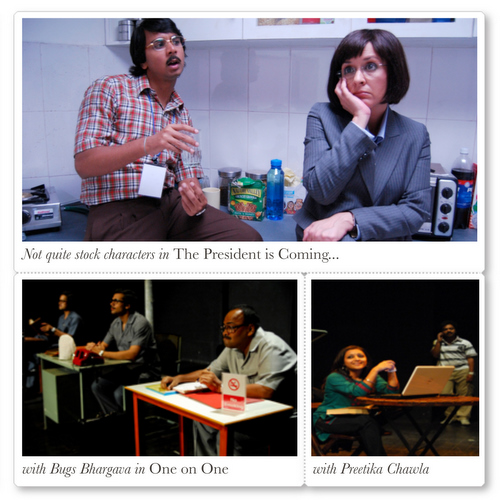 Coming to the piece on an IAS officer during three stages of his life, it was probably one of the best original pieces in that selection…
Anubhav Pal wrote it, he has written The President is Coming previously. I’m a big fan of his writing, and what I find most endearing about his work is that he is a very special kind of writer. He has found his own kind of humor, and the India that he talks about is very relevant. I just enjoy doing pieces written by Mr Pal. In that piece, Bugs Bhargav plays the main character and it’s always really interesting to bounce off his energy.
Your part in The President is Coming was a bit of a caricature…
It was in a way. Pal had written a stock-broker character. He wasn’t sure where he wanted to place it. He wanted to make him Punjabi to begin with, make him more aggressive and so on. But as the script progresses one realizes that making him Gujju, though it’s a slight caricature, creates a kind of familiarity in the audience’s mind that you then don’t have to then struggle for. It helps the audience to make the kind of connections that they have to make and it becomes very easy for me to roll with the character.
Would you have preferred something that isn’t quite so much of a stock character?
Well, it is a stock character to begin with but it depends on what you do with it. You push in its own energy into it then I think it becomes a unique character in itself. Just like the other character Ramesh (played by Namit Das) became more than just an IT person from Bangalore. It’s really up to the actor. You can make anything into a caricature, I have tried to make it as unique as I possibly could.
In All About My Mother—you played a trans character which was based on something filmed by Almodóvar but your interpretation is slightly different from the Agrado we’ve seen on screen.
Well, we rehearsed for a good four months for this play, where generally rehearsals are for two months, and that’s usually sufficient for a play. This was a world we were getting into which we weren’t familiar with and Almodóvar had made a brilliant film about it that most of our peers had seen, so the task became very difficult. In the film Agrado is played by a real-life transsexual. Her job was much easier because she was playing herself. When I approached it, I didn’t know a lot about trans identity, and I started researching a bit about it and to be very honest, it was still a little confusing to bring it out as a kind of personification. So I thought the best thing to do was how I approached a character usually, so what I did was started reading the play over and over again…
…the script Akvarious had adapted?
Yes. What I realized was that Agrado’s back story said she used to be a truck-driver. She got herself boobs but still had the genitals of a man, because occupationally that made her more desirable as a hooker. For me what really captures Agrado, was the empathy she had for other human beings, and the selfless love she had for others around her and that’s what her name means in Spanish, ‘to be agreeable to everyone’. For me the first thought was not to play a transsexual but to play this character called Agrado who happened to be one. I think that made it more believable for me from within hence probably made it more believable for the audience that watched it.
Usually when actors take on these parts, they tend to put on maybe a falsetto voice, and a kind of camp flamboyance, some little harkatein etc and that just wasn’t there in your performance. Did you consciously try to make it less stereotypical or did it just fall into place in an organic way?
When I started reading the role, at no point did I want Agrado to be a caricature of anything. Hence there was no need to put on a shrill voice, and the voice I did use ultimately became Agrado’s voice. At the same time, the flamboyance you were taking about, came from the fact that Agrado said very categorically, that she thought of herself as a Blanche (from A Streetcar Named Desire), so for me it was more like Agrado playing Blanche, and getting that flamboyance out than anything else. So I just took clues from what was in the script and working with that rather than complicating it in my head whether a transsexual should be a particular way or not. I was very happy that I got to play Agrado in this particular setup because most people, men and women included, wanted to play her. It became a little tough because everyone started telling me, ‘Oh, you’ve got the meatiest part.’
Did you think of the implications in terms of a queer portrayal…
I don’t think like that, I’m not here to break new ground. I’m here to do what I do, I do it for the fun I get from it, and I’m here to make an entertaining evening for the audience that I’m performing for. However physically, something that was a bit of a climb was walking on stilettos, to physically imagine having boobs…
…you had stuffing?
Yes, I went out with my girlfriend, and we selected lingerie and we bought padded bras where we stuffed even more padding for me and it was amazing—I couldn’t stop looking at myself (laughs). I had to shave off my arms, legs and chest… and wear a wig, a dress, heels, it took a while.
 How did your co-actors react to your transformation?
It was very strange, I’ve never been in a situation where men and women kept walking out of each other’s green rooms, without batting an eyelid. It was probably just because there were so many of us and not really because the production dealt with alternative themes where the lines are blurred anyway. In fact, Tahira Nath helped me change into my costume, I don’t know why I didn’t have a man doing it for me. Somehow, the female cast seemed far more comfortable around me when I was Agrado than they would otherwise be.
Why didn’t All About My Mother have an extended run?
We had really serious problems regarding royalties. We adapted it from the film, and we got to know that there was a stage version being performed in the UK which started asking for royalties which were just phenomenal. We approached them saying that we were an amateur group, we just don’t make that kind of money in theatre that people in the UK do, the entire royalty fee was the cost of our production. They just made it very difficult for us to function and we didn’t want to be dishonest about it and do shows without…
..but their adaptation was completely different. I’d watched in in 2007, and really the whole narrative in the Akvarious production has been re-imagined in many ways.
The director, Mr Akash Khurana, had worked a lot on the adaptation and he brought his own point of view to it. We had a Spanish gentleman who had come and watched it. He knew Almodóvar, and he had seen the film and stage versions, and he found our production very refreshing and very entertaining. In fact he wanted to go and have a chat with Almodóvar but things just didn’t work out. Monies are monies after all.
Coming to Dreams of Taleem, where you are now in the realm of alternative sexuality…
Fortunately the world of theatre that I come from is slightly more sensitive to issues of sexuality and orientations and personal choices. We’ve all come from conventional backgrounds but have made choices that are not considered conventional, for example acting. So you start being sensitive to a lot of things that are perceived as similarly unconventional. That helped. And Dreams of Taleem, in many ways, is about two men in a relationship but it is more about alternate choices, it is more about the main character (Suvrat Joshi) who plays a theatre director, it’s really his fight with his parents and the system that is around him that is almost forcing him to toe the line.
Were you, in the process of doing these two plays, educated in some way with regards to your understanding of queer identity?
Surprisingly, I had thought of myself as being much more open about it, until the rehearsals where there is a little intimate scene between Suvrat and me. I had worn a shirt that Suvrat had to unbutton, and as soon as I felt a man touching my chest, it threw me off completely. In my head that thought really helped me understand exactly how people feel about it. I happen to be straight, so for me I’ve never understood a sexual touch from a man as being arousing and I didn’t know how to react to it instinctively. Everything else we usually do in plays I respond to from an instinctive understanding of my own behavior, but when it comes to something as basic as this, as a touch in a certain context, you know that there is a difference and I had to school myself in that. The touch made it real for me.
In All About My Mother, you have a scene where a man pins you to the ground and tries to rape you, how was that different?
Well, most people have grown up with some experience of molestation whether it’s things we’ve heard of or experienced. So being pinned down by a man in that context, wasn’t an act of intimacy even it there was more touching involved—he was kissing my neck and stuff. But it wasn’t intimate, so it didn’t affect me in the way that little touch in the Dreams of Taleem rehearsals did.
Any coveted roles you’d like to sink your teeth into, from what you’ve recently seen?
There is Samuel Beckett's Waiting for Godot performed by Naseeruddin Shah, Benjamin Gilani, and Akash Khurana. When I saw it in Bombay, I just fell in love with it, the way they interpreted the lines. It is one piece I would really want to do in my life, possibly in four or five years when I’ve got some experience as an actor to be able to approach that, because it’s one of the most difficult pieces for an actor to perform.
And from an Indian context?
Well, Manav Kaul is one director I really look forward to working with. Manav and I have crossed paths many times, and we’re the greatest of friends, we’ve played a lot of cricket together, but somehow it’s happened we’ve never worked together except for a few shows of Park. I really respect his writing, and even some of his plays that didn’t quite click, like Red Sparrow, I really liked. I haven’t seen Haath ka Aaya… Shunya, but he’s been talking about it over the last two years in many ways, so I’m really interested to see it. There is a musical he’s directed called Aisa Kehte Hai, which I think is his best work.
 Are there kinds of theatre that you’re less interested in doing? Like for example, the so-called masala theatre that’s coming up…
Not at all, I’m all for what is called masala theatre. There are a lot of commercial theatre groups, and I’ve done a few commercial plays as well, with Ashwin Gidwani and so on. I think they have their own space and I completely believe that people who want to make money and profits out of theatre, they should, but they should do it well, they shouldn’t at any stage think that the audience is dumb. Dumbing down of the audience is something that should never happen in theatre because it’s probably the last thinking form left.
So what of the people who ask you to leave your brains at home in order to enjoy something they’ve staged?
They choose to see it that way, I don’t think like that. I don’t think that is possible, that you can even come and entertain yourself with your dimaag ghar pe. I don’t look down upon commercial theatre, or masala theatre and so on, and if a play is making money, and I have the time for it, and if it’s a funny enough script, I’ll not be snobbish about it and not do it. ✑

Comments