


 REVIEW: Mamtaz Bhai Patang Waale
THE KITES OF PASSAGE
In Mamtaz Bhai Patang Waale, writer/director Manav Kaul pulls no punches in delivering to the stage a unique brand of deeply felt meaningful theatre, which despite its short running time is epic in its scope because of the manner in which the little contradictions of mufossil living, the giddy aspirations of untrammeled childhood, and the forces of oppression conspire to create a sprawling tapestry of rich emotions and suppressed memories of a kind rarely unleashed on stage. The production is propped up by a crop of young actors, an infectiously ebullient lot, who transform the stage into an arena of wide-eyed wonderment and youthful enterprise so effortlessly displayed only by the truly innocent.
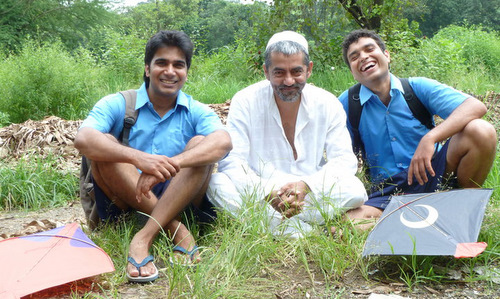
The play draws its life-force from the sport of kite-flying—a popular pastime simulated by our actors, boys and girls alike, straddling one another, rushing about trying to bring down a rival’s kite, pulling at the tethers, maneuvering the skies like little lords. There are no visuals of air-borne kites but you can almost imagine the paper tails swirling in the wind, such is the immediacy of the physical theatre on display. Many years ago, Mamtaz Bhai (Asif Basra) was the pantangbaaz of note and his prized protégé was Bikki (Saurabh Nayyar), a spirited youngster with the natural-born knack to become no mean a kite-meister himself.
Late in the play, when Vivek (as Bikki is now called) returns to the site of his anguished childhood—his wife knows nothing of his past—he meets Anand (Ghansyam Lalsa), once his excitable best friend and frequent partner in crime. Their childhood derring-do seems cached in some interminable well, as they journey together—Anand riding a bicycle, with Vivek seated behind. Actors behind a screen use shadow puppetry to create perspectives of rural living—a cow, some trees, houses separated by some distance, miles of sparseness. The bike is stationary, of course, but the journey is very palpable, and distant memories unravel to reveal the secrets of the past, if only to the audience. Much has changed. Vivek is a shiftless city-type, Anand is sedate and world-weary, and Mamtaz Bhai is gaunt and old, and lives in a decrepit hovel, far removed from the splendor of his kite-shop. The tragedy of loss is heart-rendingly etched. Mr Kaul has achieved the payoff that a successful melodrama yearns for. The performances of Mr Nayyar and Mr Lalsa are uncluttered, unaffected, and breezy.
When we first meet Mamtaz, it’s when the strains of an azaan waft across from beyond the facade of a lighted minaret, which magically opens up (the multi-purpose cast pull off the smoke and mirrors) to reveal a treasure trove of kites in his shop, while he kneels in prayer. This is almost a cipher for a deeper spiritual world that Bikki can now enter, savoring the delights that lie within, while basking in the empathy that its keeper delivers. Bikki feels proprietorial about his Mamtaz Bhai, as we watch a strange kinship unfold before our eyes, as if it places the young boy on the threshold of something that could perhaps make a man out of him. As it so happens, the promise is belied. Bikki is vengeful when he discovers Mamtaz Bhai is a family man who sells kites to earn a living, and not for some high-minded pursuit. There is betrayal and an act of impetuous rebellion.
At one level, Mr Kaul seems to call out any of the usual suspects that are customarily assembled to explain away why talent is thwarted, why the magic of childhood is so easily jaded. Geetanjali Kulkarni plays the ramrod stiff mother who doesn’t believe in sparing the rod. Umesh Jagtap, always good for a few laughs, plays a derisive school-teacher who’s unceasingly on Bikki’s case, even if he ends up as a rather benign object of ridicule with a penchant to spout pidgin English like it were Shakespeare. There are bullying school-children and a over-smart sister (played with disarming chutzpah by a young actress of great felicity, Trimala Adhikari). Tough love abounds. Oppression is made authentically pungent by little bursts of observational comedy as the actors frequently conjure up set-pieces like a crowd in a train or a queue at a ration shop, to delightful effect.
At another level, Mr Kaul seeks to create a kind of impenetrable subtext as he calls upon his cast to mimic the turmoil of the disaffected Bikki’s thoughts, his underpinnings of anxiety. The mindscapes are choreographed in a martial rhythm as the actors stomp about, whipping up a frenzy, amping up the intensity. This is theatre at its most inventive, and the story-telling enters into another realm. This isn't a play that's merely about oppressive parenting or schooling. At its most delicate, the play is akin to the reminiscing in M Ibrahim and the Flowers of the Koran. In that film (and subsequent play), a young Jewish boy breaks free from the shackles of a dysfunctional family as he befriends an old Muslim grocer, who teaches him the ways of life in laconic fashion. At its most harrowing, Mamtaz Bhai… touches upon perhaps darker ideas. A childhood has gone awry and it would appear that there is much more here than just meets the eyes. Mr Kaul seems to have censored his metaphors. He doesn’t really spend a lot of time fleshing out the unusual apprenticeship that is the play’s central relationship. Is it just about the kites? Is it just about the gravitas of Mamtaz Bhai? We need more words, more passages. We feel somewhat shortchanged by the singular act of betrayal (both by its timing, and its execution). At one point, Vivek imagines himself cradling the old Mamtaz in his arms which bizarrely becomes a laugh-aloud moment for the audience. Be that as it may, there is no real catharsis and the conflict remains unresolved. Nonetheless, Mr Kaul has pulled the wool over our eyes and we return from the theatre, mesmerized. That is a remarkable achievement in itself and a welcome return to form for the director, after the disappointing Red Sparrow.
The play will next be performed on Nov 19th at the NCPA Experimental Theatre


Red Sparrow wasn't that disappointing...
Posted by: Ajitesh Gupta | 11/10/2010 at 01:37 PM
One thing that really put me off regarding this play was when the actors would themselves laugh at the jokes rather than stay in character. I noticed that in 'The Blue Mug' earlier, and in this one the main culprit was Asif Basra. In the scene he arrives at Bikki's house and encounters his sister, although his back is to the audience he can't stop laughing himself and this has an effect on the girl's performance. Granted she is really funny, but that really breaks the mood. The actors should be professional and should always stay in character, they are not watching the play. We are.
Posted by: Srividya | 11/15/2010 at 03:29 PM
Thanks for writing in, Ajitesh. I watched the play when it first opened. They did persist with it for more shows, so maybe things fell into place into its run. Plays evolve as they go along... so maybe you're right. I'm definitely planning to watch it when it's put up next.
Srividya, it is rather off-putting when the actor reacts to the humor on stage in that way. I guess that has a lot to do with the intimacy of the theatre experience in Prithvi. Sometimes they pretend that they are in character, like in the recent Gorky+Tinku. But really, their timing is off. Everyone's guilty here, of breaking character on stage while laughing at their own lines. It is a mess. In Mamtaz Bhai I wasn't that offended. :)
Posted by: Vikram Phukan | 11/16/2010 at 08:55 AM