


 ESSAY: The Paradox of Mass Hypnosis
HAMLET WITH CLOWNS
In Hamlet The Clown Prince, Rajat Kapoor presents us with an assured piece of theatre that combines comic farce with an ostensible element of tragedy through the performing of Shakespeare’s Hamlet in a play within the play by a set of rambunctious clowns with joie de vivre to spare. The promotional literature advertises the play’s selling point as that it is delivered in something called ‘gibberish’ (and some say it’s Hebrew, and others Yiddish—all kinds of rumors abound). This is a misnomer. There is a natural flow of query and response understood and spoken by the denizens of this realm. They get each other, there is a constant back-and-forth and verbal scuffles that could teach almost anyone a thing or two about oneupmanship. The characters don’t spend any time trying to make sense of the proceedings. Neither do we, we dive straight in, the concocted phrases become second nature, nothing ever descends into meaninglessness. It’s all very clever, and words need to sometimes come garbled across in what appears to be an effortless spiel. Therefore 'gibberish' is not quite the right epithet.
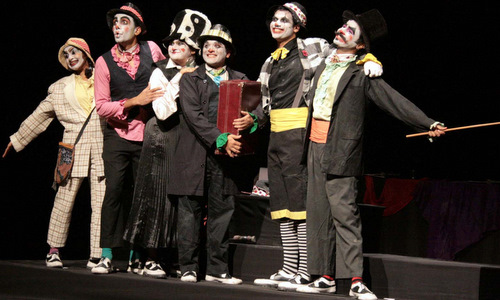
This is a true ensemble piece. There are broader aspects to the comedy; slapstick rears its head on occasion like when talcum powder is spilled onto the stage—a slippery surface always garners a lot of laughs. Charades are wonderfully put to use when the ghost of Hamlet’s father needs to impress upon him the circumstances of his death without uttering a word as is the wont of all traditional spooks. Then there are sexual innuendos that seem to work quite well as part of a Venus and Mars dynamic between the clowns Soso (Atul Kumar) and Bouzo (Puja Sarup), who are star-crossed lovers , even if they also enact Hamlet and Gertrude respectively in the play within, an unlikely Oedipal mother and son pair if ever. Then there are the popular references thrown in, like a rather lame Lion King running gag and a mention of someone being manglik, which has the audience in thrall. All of it seems squarely aimed at evoking crowd reactions in more accessible ways but these elements are merely ephemeral when placed in the context of the actual nature of this kind of theatre. There is a sense that although we have a whole audience caught up in the sway of a dazzling display of mass-hypnosis, the actual gags are falling flat on their faces. Gestures get the most laughs, not nuances. When Mr Kapoor panders to his audience he has them eating out of his hands, when he settles in for something more elemental they’re simply not engaged, maybe still under some kind of spell, but the choice bits are passing them by. The transition from performance to audience isn’t seamless. There are two planets here—the ‘drunks’ get a night out, and the actors find themselves a luminous showcase but they do seem to be performing in vain. They bring them in with bait, and hope they’ll return with the goods of the oceans. This can never be the case.
These are not pathetic clowns with big sad eyes or little dawdling duck-like movements, working up a lather of emotion for the whole dichotomy of a clown’s existence, ever ready to shoot upwards into bathos. No, we don’t have crying clowns here. Bonhomie is the creed. No circus clowns either, with large red noses or flying trapeze acts. They are not fleet-footed except when engaging in repartee. When Soso announces, ‘In the end everybody dies!’ in that faux Italian accent, it’s almost as if he is foreshadowing a point of pathos. And there is one, a transfiguring moment of tender emotion between Hamlet and Ophelia that is sprung up on us quite unexpectedly. Rachel D’Souza as Fifi (diminutive for Ophelia?) almost runs away with the show with her West Caribbean inflection and ferret-like feistiness. In Shakespeare’s original the only clowns were grave-diggers speculating on Ophelia’s suicide, here Fifi is the definitive clown, her descent into madness is the play’s most affecting episode.
Also looming is the scenery-chewing Puja Sarup as Buozo, although in her performance the whole act does waver from its chosen dictum because she is occasionally allowed to step outside the ensemble. This is probably because of her well-heeled standing in theatre circles, she has recently top-lined a production of Almodóvar’s All About My Mother. Ms Sarup is allowed a more lingering stop-over in the spotlight, but it does bring about a kind of pause to the action. This is not really a grouse because she does give in to her performance consummately and is a comedienne par excellence.
The play within the play is a theatre of the absurd and lends itself easily to improv. The clowns spontaneously come up with tropes and tics, making things up as they go along, pulling the strings with lip-smacking glee. The timing is impeccable, giving Hamlet.. the quality of madness, to which there always seems to be a well-etched method, all the while eschewing the conventional narrative for something organic. But from a distance, you do feel you’re watching a performance not by a clown theatre company but by Mr Kapoor’s troupe. The seasoned performers bring with them the baggage of effortlessly passing off the tried-and-tested as something unrehearsed and free-form. You can see through the act, but you’re still thoroughly entertained, so it isn’t all bad.
Where does it all come from, one may question? Did Mr Kapoor just conjure it all up from nowhere, draw it out from a top hat? Is this all really his hyperactive sub-conscious being allowed to spill over and create something subliminal? Or is it merely derived? It does doff a hat to Molière at times. Author Martha Bellinger had pointed out that Molière “has been accused of not having a consistent, organic style, of using faulty grammar, of mixing his metaphors, and of using unnecessary words for the purpose of filling out his lines.”
This is the way they do it here, the exposition, the language used in different ways, the concoction of myriad accents. Buozo flails about like a Russian Pollyanna with a French accent. Fifi’s mastered the slang of the bordello. The only thing incongruous is Papa Ghost’s square Indian English accent. Maybe the actor (Neil Bhoopalam) couldn’t feign a stereotypical brogue well enough. A convent school inflection does always seem clichéd in the context of Indian theatre in English and it doesn’t ring true here either where everything else is a re-imagining, fresh as a breeze. But his is a bravura performance, and he seems to grasp physical comedy incredibly well, and laces it with a dash of sexiness. He has all the right moves if not the right articulation. The death scene of Papa Ghost is a rare feat, and you half believe he’ll be called back for an encore and die once again, suspension of disbelief be damned.
Is the fluency of it all really just western theatre being mastered on an Indian stage? We’re not perturbed by the borrowing from Shakespeare. Shakespeare has become so basic, so rudimentary that it’s universal now, not western or occidental, it’s local to any context. It is versatile in its uses, lending itself to a sense of being acculturated almost. Whereas the staging of it, the debauchery, the loudness of it all, the vaudeville style evoke all kinds of other influences—Brecht, Molière, elements of Italian dialect theatre and Commedia dell'arte. The masks for instance—well they are clown masks, but painted on like this was a harlequinade.
Derived doesn’t necessarily mean a bad thing. It’s not pejorative since mimicry is the best kind of flattery. There are derived works we have great respect for. Hamlet.. appropriates western elements so fluently that it is now a crown jewel on the Indian theatre scene, a marvel of our times. There are moral fables that need to be recounted ad nauseum and even if we cannot immediately enter Mr Kapoor’s head and break into his foundry of ideas, it’s not important because it doesn’t quite take away from the virtuosity of this piece. And there is also a lot here so inordinately original—so much warmth emanates from the cast when an imaginary needle is used to stitch together emotions as it were; or when the prompters at the theatre put up a rib-tickling side-show that assumes centre-stage proportions; the scene involving Soso merely going through the motions, one action after another, right through to an imaginary strip-tease that has people transfixed and waxy-eyed. Hypnotized.
At times Soso is belligerent and makes fun of his audience. We can only presume he’s Mr Kapoor’s alter-ego, complaining about having to dilute the purity of his work with crowd-friendly invective or something ridiculous like Buozo’s skirt being pulled down. She’s not one to be cowed down by it though and baits some hapless man in the audience with her red stocking garters. Not really as audacious as red knickers maybe, but it will do. This has usually been a straight-laced audience after all, even if they’ve been lapping up The Vagina Monologues for years, but that’s considered respectable now, not prurient. There is a self-conscious bravado with which they subject themselves to this onslaught of interactive theatre. They cannot not revel in this kind of blood-letting, it’s just not done. This is not theatre for the bourgeoisie, or people who’ve just about arrived, not exposed to one-offs of this kind with any great consistency to develop a taste for what it actually is. They’re like British audiences, who are ever prepared to laugh their way through even the most dour production of The Glass House. The ‘drunks’ are not drunk literally. They’ve learnt to stand up for ovations (peer pressure, mainly) without summoning the requisite amount of applause that could cause the troupe to return for seconds, enthusiastic as they are only for the first few introduced characters in a line-up. This is a cool, hep, homogenous, effectively Prithvi-ised audience, sold on culture, condoms and chai (sulaimani preferably).
The tragedy of Hamlet the Clown Prince is the self-importance of its patrons. There isn't a cultural frame of reference in which it can be placed. The best theatre borrows from its audience, from what is local, indigenous, of the people. The National Theatre of Scotland, for example. It doesn’t stand in isolation and preach new wares, or a new evangelical style. This has the colloquial accents down pat, but they are from elsewhere. The milieu in which it exists, in which it’s created and performed and fluently mastered is not a reflection of what’s really out there here. Is this is a kind of fringe theatre masquerading as a top-ticket show and pulling in the crowds who may have been spellbound by Ophelia’s pièce de résistance crazy-woman act, but that’s not identification or engagement. The question remains, what business do you have to set up your tent and put on your ringmaster outfit just raring to crack a whip or two, and there are lions, but only an illusory audience?


Super VP!
Posted by: Deepa Gahlot | 09/14/2010 at 09:35 PM
This essay was on the rant-o-licious side (which is not a bad thing - but certainly a potent dose)... i like how you did finally get around to your core question of "where's this coming from?" - i almost wish it started and warmed up from there...
btw, you are borderline abusive towards the Prithvi-ised audiences.
no one really cares about their ability to access meaning/suggestion most likely; they're an adequately valid and available local test audience (with their own certain charm and literacy to boot) for creators with larger aspirations. you're such a romantic when it comes to artist connecting with immediate audiences :-)
Posted by: Fernando Delgado | 09/16/2010 at 12:27 PM
You're right, it's a rant. But not an indictment, I absolutely adored this production. It just seemed to me like there were two different universes there. The folk on stage were totally on their own trip - it's like 'we've got your money, now catch up with us!' The folk in the audience were falling all over themselves with helpless laughter, while being totally oblivious! I know I can't really get into their heads, but I had never seen something like that, ever! Only in India, I guess. Or maybe, the future's here.
Now when I go and watch something like S*x, M*rality & Cens*rship - then it's all homogenous. The play, the actors, the people.
Two great nights out, all in all. I'm not complaining.
Posted by: Vikram Phukan | 09/16/2010 at 01:18 PM