At high-profile international film festivals, a measure of the event's success (other than the films it manages to get, of course) is the star turnout. By that yardstick, the 12th Mumbai Film Festival which concluded last night, wasn't particularly impressive. Barring Prem Chopra who did the rounds at PVR almost everyday and gleefully signed autographs, sipped coffee and walked out of screenings, the star quotient was abysmally low. There were the lesser known actor-stars like Raghubir Yadav, Ranvir Shorey, Vinay Pathak, Rajat Barmecha etc. who queued up for the odd screening, and there were filmmakers -- Shriram Raghavan, Anurag Kashyap, Leena Yadav -- who'd turn up now and then.

Continue reading "REPORT: 12th Mumbai Film Festival Overview " »
DOES THE MARKET REALLY UNDERSTAND GAY?
Cinema in India, kitschy for most, emotionally overwrought for many others, sometimes pats itself on the back for taking on the contentious issues of the times. Terrorism has been tackled as charged erotic drama; honor killings suitably poeticized; the recent Commonwealth Games imbroglio will find some self-styled guerilla film-makers out there—then there is this perception that gays have been ‘liberated’ because of that much tom-tommed Section 377 ruling last year. (Incidentally, it is still pending appeal in the Supreme Court having now assembled a pack of religious types as opponents to the motion; but that’s just a niggling detail.) There is a sense that people want to float suspended in a bubble, reveling in its iridescence. It’s like Mr Clooney, sexiest man alive, talking of how Hollywood paved the way for civil rights by giving an Oscar to Hattie McDaniel for playing a southern mammie in Gone With The Wind. Well, she sat at the back of the room and wasn’t even allowed her own speech. It doesn’t really matter what the reality on the ground is. Change is a bewitching concept even if it is entirely superficial.

Continue reading "ESSAY: State of the Queer" »
GOD OF ALL THINGS
By Joyojeet Pal
During the release of Sivaji in 2007, I dutifully showed up for the first day first show outside San Francisco. The tickets for the first show had been sold out within ten minutes of the day they were open for purchase. I gratefully made an underhand deal with the theatre owner for a folding chair in to be placed in front of the first row of seats for $20. At the theatre, I realized I wasn’t the only joker willing to do this, there was a long line flush with Veshtis and already screaming fans, on one side of the box office waiting for their portable chairs. Worse, I signed up my fiancée, who spoke no word of Tamil, and was clearly disconcerted by the ominous signs of what seemed likely to follow. Further, the film was late, with all of us waiting in line. The wait gave me no sense of disgust or irritation at the prospect of my likely neck-craning experience, rather increased the excitement of anticipation.
Continue reading "ESSAY: Enthiran" »
THE WOMAN WHO WANTS TO BE A MAN
by Joyojeet Pal
Read Part 1, Part 2
One look at the depiction of women driving car and two-wheeler drivers in Tamil cinema, and one needs little further evidence that a woman ought not to cross into a man’s domain. The office secretary is a traditionally gendered occupation and easy to depict sexually and trivialize. In fact, the secretary poses no serious threat to the supremacy of a man in the workplace, since, at least in office scenarios, the secretary reports to a man. An area of greater contestation is jobs where women replace men. Here, the focus is not only on the sexual complexity of a woman in the male domain of offices, but also on her neglect of her feminine duties through holding a job.

Continue reading "ESSAY: Women Who Have Jobs And Other Troublesome Pursuits (Part 3)" »
VAMPITUDE
by Joyojeet Pal
Read Part 1
Vampitude here is defined as the desire of a woman to undermine the rectitude of a man, usually with her sexuality as her primary weapon. The mythological nymph Menaka who helped trip over the sage Vishwamitra with her wiles is our exemplar. The classic though unwitting vamp of Tamil literature is Madhavi, the dancer who Kovalan, the husband of the virtuous Kannagi moves in with in Silappatikaram. In the epic, the dancer is herself an intellectual, and a deeply complex character who eventually gives up her life for monkhood, though RS Mani’s popular pre-independence screen adaptation (Kannagi, 1942) of Madhavi was that of a seductress, and the bête noire of Kannagi, the iconic heroine in waiting. In short, Madhavi is the starting point Kodambakkam vampitude.

Continue reading "ESSAY: Women Who Have Jobs And Other Troublesome Pursuits (Part 2)" »
By Joyojeet Pal
In 1973, K Balachander made Arangetram. In the film, the eldest daughter of a rural orthodox Brahmin family moves to the city to get a job. She is forced by circumstances to earn a living as a prostitute, but works her family out of poverty. In 2000, Rajiv Menon made Kandukondain Kandukondain. A rural Brahmin family is likewise impoverished, and the eldest daughter must negotiate life in a city to earn a living. She gets a job as a software engineer, and works her family out of poverty.
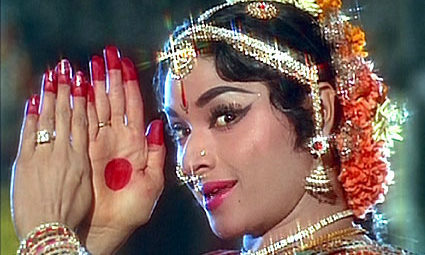
Continue reading "ESSAY: Women Who Have Jobs And Other Troublesome Pursuits (Part 1)" »
By Joyojeet Pal
The decline of Sunny Deol into near
B-moviedom is an important indicator of the market reorientation towards upper
class sensibilities in Hindi cinema. The fight scene is not gone entirely, but
between the gloss of romances set in Switzerland and multi-starrer screwball
comedies set in Goa, the regular visual ethic for the multiplex audiences of
Hindi film watchers is increasingly less crusty. The one-man army bashing up a
line of extras is more or less disappearing from the Hindi film narrative. As
the prices of theatre tickets slide past the affordable ranges for the urban
poor, Mithunda’s retirement from lead
star makes timely space for a the rise of Bhojpuri cinema. Here, as in most
vernacular cinema, the ceremonial bashing remains a necessary reinforcement of
the protagonist’s masculinity and a guaranteed quencher of the audience’s blood-thirst
at the end of a ticket price worth of air conditioning.
Continue reading "ESSAY: Cinematic Realism & the New Tamil Bloodfest" »
PUTTING MEANING INTO CINEMA
Why does Elizabet Vogler (Liv Ulmann) go silent in Ingmar Bergman’s Persona? The first time I watched this stunning and complex film, I wondered more about the form than the content. Because having grown up on a diet of one-dimensional cinema, it was very difficult to comprehend this non-linear approach to filmmaking. There was a deliberate attempt on the director’s part to elaborate on the ‘make-believe’ world of cinema -- on the ‘illusion of reality’.
This time, I focussed on the content. Because despite it’s seemingly ‘fragmented’ plot, there is a narrative unity, albeit deliberately broken by the filmmaker from time to time. "For the interpretation, you can interpret it any way you like. As with any poem. Images mean different things to different people" – Ingmar Bergman.
Continue reading "DVD REVIEW: Persona (1966)" »
LOVE AND LUST IN BOLLYWOOD
I was on the edge of my seat while watching Kites yesterday. In my naiveté I presumed this would be the day Bollywood would consummate love on screen. After all, the setting was perfect. The hero is an American citizen with no 'maa', 'pitaaji' or 'khandaan ki izzat' to hold him back (although men aren't generally weighed down by 'izzat', it's the woman's department to shoulder that). The heroine is Mexican and in America to marry her way to riches. Then, as a bonus, they're already legally wedded -- he as 'groom for hire', she for American citizenship -- in an arrangement of convenience, but by Hindi film conventions, at least they're married. They're both terribly handsome, can only look at each other's eyes and bodies and feast, because they don't speak the same language and hence their so-called romance must hinge on lust alone. Now you think shackles that have bound Hindi film lovers behind an invisible 'purdah' for decades will be broken forever.
Continue reading "ESSAY: Kiss And Tell" »
THE BALLAD OF CHARLIE AND MIKHAIL
THE buddy film, so eagerly lapped up by queer audiences in the past, has in recent times been ‘found out’. In the past, these films provided a gay subtext that overpowered everything else going on on-screen, a subtext that, although almost snatched from the proceedings, had become the inexorable parables for the lives of gay men. What they were led to believe was that being embroiled in a strong self-sacrificing friendship could be a viable stand-in for a love match. This kind of cinema turned out to be the albatross around their necks that inhibited them from venturing into untested waters as gay men who wanted more than just the idea of another man as a heroic counterpart, but men in the flesh, who could be losers or slime-balls, men who were the objects of their carnal desire and a kind of adoration that wasn’t quite the stuff of epic films, men who gave them love-bites and nothing else besides, things that they hadn’t quite seen on celluloid. In this, the buddy films and their unflinching devotion to them have become somewhat anachronistic as gay men slowly learnt, without any help from popular culture, that love needed no surrogates. Gestures were more important than nuance and that stories of homosexual love needed no longer be seen as merely fine print, or be read only between the lines.
Continue reading "ESSAY: From Midnight Cowboy to Kaminey" »


Recent Comments