


 INTERVIEW: Umesh Kulkarni (Part 2)
Can you describe your journey to becoming a filmmaker?
I never wanted to be a director and was one exam away from qualifying as a Chartered Accountant. But I was interested in the arts and in architecture. While in college I joined Sumitra Bhave and Sunil Sukhtankar on Doghi, their directorial debut, as they were looking for young boys to assist them with the project. When I saw the film I realised that it was very different from the shooting process and that it involves all the activities that interest me––theatre, literature, dance, music and spaces.

While I finished my college education, I worked with Bhave-Sukhtankar both on feature films and documentaries. FTII was actually shut for two years around that time. Fortunately it reopened and I cleared the exam in the first attempt. My family supported my decision and I feel fortunate because many people have to go the conventional route because of domestic pressures. My mother was a little worried and asked me to finish my CA so I’d have a fallback option. But I felt I had to do it when I did. It was a spontaneous decision.
What did you take away from your years at the Institute?
Entering that world was the most crucial decision of my life––I finally started getting a sense of what I wanted to do. We had to make very short films of two and five minutes length which was a great learning experience. It helped me a lot in finding the courage to tell my own stories. The FTII has played a big role in my cinema, along with Bhave-Sukhtankar and my theatre group who joined me for Valu.
Apart from your formative years with Bhave-Sukhtankar, you never worked as an Assistant Director but decided to raise funds and make your first feature film. That was a brave decision…
My FTII film Girni got the National Award for Best Short Film. Girish and other friends joined me and I decided to go with my gut feeling and started working on Valu. We were really innocent then, which helped, because we weren’t thinking too far ahead to get daunted by the problems of film production. Girish wrote the script and I planned the visuals.
How did you raise funds for the film?
Even though some senior actors had liked the script and agreed to work with us, getting a producer was a problem. Finally we decided to ask our friends and family and friends of family and family of friends and so on to eventually raise Rs. One crore. After the film was ready, Mukta Arts saw it and bought it from us with a minimum guarantee and took care of the publicity and promotions.
Ironically, two years after Valu I saw a newspaper article about a bull who was chased and caught. So life and cinema feed off each other.
What was it like directing such a huge cast in your first film?
It was a big challenge because most of the 35 actors we had were well-known figures. Combining their dates and styles was a challenge. To make it a homogenous, organic film was a challenge. But the biggest challenge was the funding. The actors were my angels. They kept their faith and were very helpful throughout the making of the film.
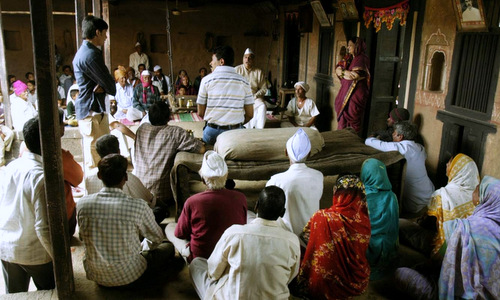
What is your relationship with Girish Kulkarni like? How do you work together so well?
We have been close friends ever since we started doing theatre together 17 years ago. Both of us are very different individuals who complement each other well. We have faith in one another and we have some common threads. Girish is a great actor and writer and his presence in my films is very important. His strength as an actor is that he doesn’t try to enact a character but becomes it. Few actors in Indian cinema perform this way. And his writing has an easy natural flow.
You both have started your own production house...
Yes, we are trying to ease the troubles of our friends who want to make good cinema. Producing quality films is also a great challenge. I can’t direct films one after the other. In India the producer is considered the man who puts his money on a film. But this isn’t true. The producer should also have a creative stake in the project. We are approaching our productions in this way because we have an intimate relationship with these films. We want to make good films and we enjoy the production process.
Who are the filmmakers you enjoy watching?
My favourite Indian directors are Ritwik Ghatak, Satyajit Ray, Girish Kasaravalli, Guru Dutt, G. Aravindan and Bhave-Sukhtankar. Internationally, I like Fellini, Tarkovski, Bresson, Ozu, Kiarostami and Wong Kar-Wai. My favourite films are Where Is The Friend’s Home?, La Dolce Vita, Subarnarekha, Aparajito, Andrei Rublev and Mirror among many others.
How would you describe your relationship with your environment, since that’s an important preoccupation in your work?
My ancestral village is in the Satara district and I feel an elemental connection with the Sahyadri Hills. I love going out of the city and also like meeting new people, particularly in rural areas. The place where we stay, our environment, has a deep-rooted connection with our individual personalities. Similarly, the villages where we have shot our films have also become a part of the exploration process because the villagers have gone out of their way to accommodate us and brought their positive energy to our work.
What kind of feedback have your received for your films?
It’s always the individual connection that matters most. Like a parent who told me her two-year-old son doesn’t have his food without watching Valu. I met a young girl in South Korea after the screening of Vihir who was so moved, she said, “You have made my film,” in a choked voice. These are the responses that I cherish.


I am a huge fan of Umesh, loved his work on Vihir, probably the most profound movie in the past 10-15 years of Indian Cinema. I once ran away from home when I was 14 and somehow Vihir took me back to those confusing days, those days still perplex me and Vihir gave me many answers and the water symbolism was terrific. Valu was perfect too, with the whole idea of free spirit was amazing. Deool was good though i felt it could've been a little tighter, but anyways Umesh Kulkarni is my favourite filmmaker in the current Indian cinema circuit. I once told one of my friends, he is the Kiarastomi of Indian Cinema and quite co-incidentally he too likes Kiarastomi. I wish we could have a few more directors like him and then who would need to visit those film festivals for good movies when they could get released at a theater near you.
Posted by: Krunal | Nov 28, 2012 at 15:17